MCQ
Which of the following quantities has a unit but dimensionless?
  • A
    Strain
  • B
    Reynold's number
  • Angular displacement
  • D
    Poisson's ratio

Answer

Correct option: C.
Angular displacement
c
(c)

Angular displacement has unit (degree or radian) but it is dimensionless.

Need a full question paper?

Generate a complete, print-ready paper with questions like this in minutes — across 16+ boards, with answer keys.
Start Generating Free

Similar questions

$Assertion :$ A body that is good radiator is also a good absorber of radiation at a given wavelength.
$Reason :$ According to Kirchhoff’s law the absorptivity of a body is equal to its emissivity at a given wavelength.
Which of the following is not an example of perfectly inelastic collision
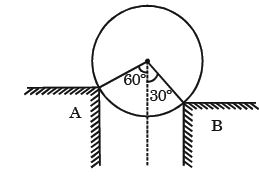
A smooth cylinder of mass $m$ and radius $R$  is resting on two corner edges  $A$  and $B$  as shown in fig. The relation between normal reaction at the edges $A$ and $B$  is
Which of the following pairs of physical quantities does not have same dimensional formula?
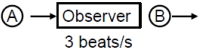
Two sources of sound $S_1$ અને $S_2$ are moving towards and away from a stationary observer with the same speed respectively. Observer detects $3$ beats per second. Find speed of source (approximately). (in $m/s$)

Given, $F 1= F 2=500\, Hz$. speed of air $=330\, m / s$
A man is standing on a balance and his weight is measured. If he takes a step in the left side, then weight
In an engine the piston undergoes vertical simple harmonic motion with amplitude $7\, cm$ . A washer rests on top of the piston and moves with it. The motor speed is slowly increased. The frequency of the piston at which the washer no longer stays in contact with the piston, is close to ...... $Hz$
A simple pendulum executing $S.H.M.$ is falling freely along with the support. Then
A scooter of $40\,kg$ mass moving with velocity $4\,m/s$ collides with another scooter of $60\,kg$ mass and moving with velocity $2\,m/s.$ After collision the two scooters stick to each other the loss in kinetic energy .............. $\mathrm{J}$
A stone of mass $150\ g$ moves in a vertical circle on the end of a length of string. The radius of the cirlce is $70\ cm$ and the speed of the stone at the topmost point $P$ is $3.5\ m/s$ . For the instant at which the stone passes through the highest point $P$ , the centripetal force is nearly    ......... $N$ (take $g = 10\ m/s^2$ )