MCQ
Which of the following reaction forms aldehyde as a product
  • $CH \equiv CH\,\xrightarrow[{333\,\,K}]{{H{g^{ + 2}}/{H_3}{O^ \oplus }}}$
  • B
    $C{H_3} - C \equiv CH\,\xrightarrow[{333\,\,K}]{{H{g^{ + 2}}/{H_3}{O^ \oplus }}}$
  • C
    $C{H_3} - C \equiv C - CH\,\xrightarrow[{333\,\,K}]{{H{g^{ + 2}}/{H_3}{O^ \oplus }}}$
  • D
    $A$ and $B$ both

Answer

Correct option: A.
$CH \equiv CH\,\xrightarrow[{333\,\,K}]{{H{g^{ + 2}}/{H_3}{O^ \oplus }}}$
a

Need a full question paper?

Generate a complete, print-ready paper with questions like this in minutes — across 16+ boards, with answer keys.

Start Generating Free

Similar questions

When ${C_6}{H_5}\mathop N\limits^ \oplus  {H_3}\mathop {Cl}\limits^\Theta  $ salt is dissolved in water it gets hydrolysed then find equilibrium  constant of the hydrolysis reaction. If ionisation constant of weak base is $10^{-4}$
$A\mathop {\xrightarrow{{{K_2}C{r_2}{O_7}}}}\limits_{{\text{dil}}{\text{. }}{H_2}S{O_4}} B\mathop {\xrightarrow{{C{H_3}MgI}}}\limits_{{H_2}O} $ $\begin{array}{*{20}{c}}
  {\begin{array}{*{20}{c}}
  {\,\,\,\,\,\,\,C{H_3}} \\ 
  | 
\end{array}} \\ 
  {C{H_3} - C - C{H_3}} \\ 
  | \\ 
  {\,\,\,\,\,OH} 
\end{array}$ The reactant  $A$  is
Ratio of energy of photon of wavelength $3000\,\mathop A\limits^o $ and $6000\,\mathop A\limits^o $ is
The numbers of moles of $BaC{O_3}$ which contain $1.5$ moles of oxygen atoms is
If $1.2\, g$ of metal displace $1.12\, litre$ hydrogen at normal temperature and pressure ,equivalent weight of metal would be
The vapour pressure of pure benzene at a certain temperature is $0.850\,bar$. A non-volatile, non-electrolyte solid weighing $0.5\,g$ is added to $39.0\,g$ of benzene (molar mass $78\, g/mol$ ). The vapour pressure of the solution then is $0.845\,bar$. What is the molecular mass of the solid substance ?
Consider the following

$Zn^{2+} + 2e^-$ $\longrightarrow$ $Zn (s) ; E^o = -0.76\,V$

$Ca^{2+} + 2e^-$ $\longrightarrow$ $Ca (s) ; E^o = -2.87\,V$

$Mg^{2+} + 2e^-$ $\longrightarrow$ $Mg (s) ; E^o = -2.36\,V$

$Ni^{2+} + 2e^-$ $\longrightarrow$ $Ni (s) ; E^o = -0.25\,V$

The reducing power of the metals increases in the order

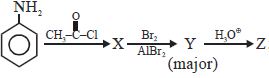
$Z$ is
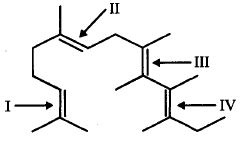
In the following structure, the double bonds are marked as $I, II, III$ and $IV$ Geometrical isomerism is not possible at site $(s)$
The conjugate base of $H _2 PO _4^{-}$is: