MCQ
Which of the following reactions is reversible
  • ${H_2} + {I_2}\xrightarrow{{}}2HI$
  • B
    ${H_2}S{O_4} + Ba{(OH)_2}\xrightarrow{{}}BaS{O_4} + 2{H_2}O$
  • C
    $NaCl + AgN{O_3}\xrightarrow{{}}NaN{O_3} + AgCl$
  • D
    $Fe + S\xrightarrow{{}}FeS$

Answer

Correct option: A.
${H_2} + {I_2}\xrightarrow{{}}2HI$
a
It’s Obvious

Need a full question paper?

Generate a complete, print-ready paper with questions like this in minutes — across 16+ boards, with answer keys.

Start Generating Free

Similar questions

Isostructural species are those which have the same shape and hybridization. Among the given species identify the isostructural pairs.
In $C{H_3}C{H_2}OH,$ the bond that undergoes heterolytic cleavage most readily is
2.84gms of methyl iodide was completely converted into CH3​MgI and the product was decomposed by the excess of ethanol. The volume of the gaseous hydrocarbon produced at NTP will be_________.
Which of the following set of quantum numbers are allowed ?
Arrange the following hydrogne halides in order of their decreasing reactivity with propene.
${\text{Alkene}}\xrightarrow{{{\text{Ozonolysis}}}}{\text{2,6}} - $ heptandione Find alkene
Generally pi bond is formed from the lateral overlap of:
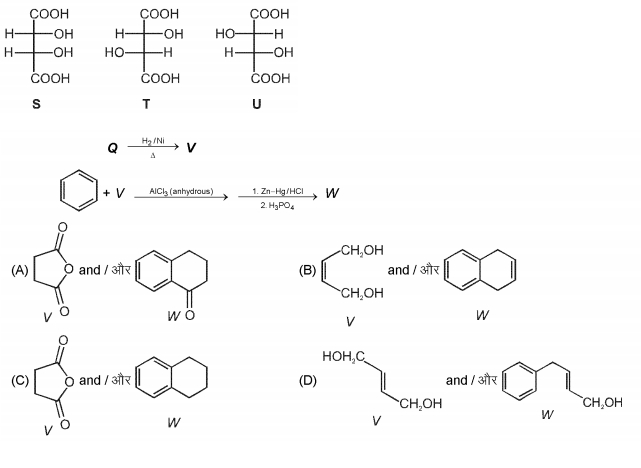
$P$ and $Q$ are isomers of dicarboxylic acid $C _4 H _4 O _4$. Both decolorize $Br _2 / H _2 O$. On heating, $P$ forms the cyclic anhydride.

Upon treatment with dilute alkaline $KMnO _4, P$ as well as $Q$ could produce one or more than one from $S , T$ and $U$.$Image$

$1.$ Compounds formed form $P$ and $Q$ are, respectively

$(A)$ Optically active $S$ and optically active pair $(T, U)$

$(B)$ Optically inactive $S$ and optically inactive pair $(T, U)$

$(C)$ Optically active pair $(T, U)$ and optically active $S$

$(D)$ Optically inactive pair $(T, U)$ and optically inactive $S$

$2.$ In the following reaction sequences $V$ and $W$ are respectively :$Image$

mcq $Image$

Give the answer question $1$ and $2.$
$H_2 + Cl_2 \longrightarrow 2HCl$ ; $\Delta H = -x\,kJ$
$NaCl + H_2SO_4 \longrightarrow NaHSO_4 + HCl$ ; $\Delta H = -y\,kJ$
$2H_2O + 2Cl_2  \longrightarrow 4HCl + Cl_2$     ;   $\Delta H = -z\,kJ$
From above equation the value of $\Delta H_f$ of $HCl$ is
French chemist ____ laid the foundation to the scientific investigation of matter by describing that substances react by following certain laws.