MCQ
Which of the following relation is correct :
  • Heat capacity = specific heat $\times$ mass
  • B
    Specific heat = mass $\times$ heat capacity
  • C
    Heat capacity = mass/specific heat
  • D
    Specific heat = heat capacity

Answer

Correct option: A.
Heat capacity = specific heat $\times$ mass
A

Need a full question paper?

Generate a complete, print-ready paper with questions like this in minutes — across 16+ boards, with answer keys.

Start Generating Free

Similar questions

$2\, kg$ of ice at $-20°C$ is mixed with $5\, kg$ of water at $20°C$ in an insulating vessel having a negligible heat capacity. Calculate the final mass of water remaining in the container. It is given that the specific heats of water and ice are $1\, kcal/kg\, per °C$ and $0.5\, kcal/kg/°C$ while the latent heat of fusion of ice is $80\, k\,cal/kg$ ........ $kg$
An ideal gas in a closed container is slowly heated. As its temperature increases, which of the following statements are true$?$

$(A)$ the mean free path of the molecules decreases.

$(B)$ the mean collision time between the molecules decreases.

$(C)$ the mean free path remains unchanged.

$(D)$ the mean collision time remains unchanged.

Construction of submarines is based on
What can you say about the motion of an object if its speed-time graph is a straight line parallel to the time axis?
The ratio of specific heat capacity to molar heat capacity of a body:
The weight of an astronaut, in an artificial satellite revolving around the earth, is
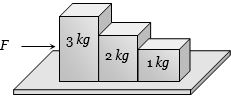
Consider the following statements about the blocks shown in the diagram that are being pushed by a constant force on a frictionless table

$A.$All blocks move with the same acceleration

$B.$The net force on each block is the same

Which of these statements are/is correct
$1$ mole of $H_2$ gas is contained in a box of volume $V = 1.00m^3$ at $T = 300K.$ The gas is heated to a temperature of $T = 3000K$ and the gas gets converted to a gas of hydrogen atoms. The final pressure would be $($considering all gases to be ideal$).$
The disc of a siren containing $60$ holes rotates at a constant speed of $360\,rpm$. The emitted sound is in unison with a tuning fork of frequency .... $Hz$
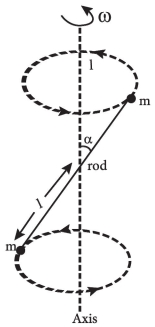
A massless rod $S$ having length $2I$ has equal point masses attached to its two ends as shown in figure. The rod is rotating about an axis passing through its centre and making angle $\alpha$ with the axis. The magnitude of change of momentum of rod i.e. $\left|\frac{ dL }{ dt }\right|$ equals