MCQ
Which of the following represent friedel-craft reaction
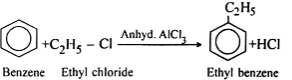
  • ${C_6}{H_6} + {C_2}{H_5} - Cl\xrightarrow{{AlC{l_3}}}{C_6}{H_5} - {C_2}{H_5} + HCl$
  • B
    ${C_6}{H_5} - OH + HCl\xrightarrow{{ZnC{l_2}}}{C_6}{H_5}Cl + {H_2}$
  • C
    ${C_6}{H_5} - Cl + C{H_3}COCl\xrightarrow{{AlC{l_3}}}{C_6}{H_5}COC{H_3} + C{l_2}$
  • D
    $C_2H_5-Br+Mg \xrightarrow {ether}C_2H_5MgBr$
Answer

Correct option: A.
${C_6}{H_6} + {C_2}{H_5} - Cl\xrightarrow{{AlC{l_3}}}{C_6}{H_5} - {C_2}{H_5} + HCl$
a
Correct option is ($A$).

Need a full question paper?

Generate a complete, print-ready paper with questions like this in minutes — across 16+ boards, with answer keys.

Start Generating Free

Similar questions

When ethene undergoes addition reaction with chlorine, it gives:
The sum of the total number of bonds between chromium and oxygen atoms in chromate and dichromate ions is
Dipole moment is shown by
The solubility of $PbF_2$ (formula weight $= 245$) is $0.46\,g/L$. What is the solubility product
Which halide of nitrogen is least basic
$\begin{array}{*{20}{c}}
  {\,C{H_3}\,\,\,\,\,\,\,\,\,\,\,\,\,} \\ 
  {|\,\,\,\,\,\,\,\,\,\,\,\,\,\,\,\,\,\,} \\ 
  {C{H_3} - C - C{H_2} - \mathop C\limits^ \oplus  {H_2}} \\ 
  {|\,\,\,\,\,\,\,\,\,\,\,\,\,\,\,\,\,\,\,} \\ 
  {C{H_3}\,\,\,\,\,\,\,\,\,\,\,\,\,\,} 
\end{array} \to \begin{array}{*{20}{c}}
  {\,\,\,\,\,\,\,\,\,\,\,C{H_3}} \\ 
  {\,\,\,\,\,\,|} \\ 
  {C{H_3} - \mathop C\limits^ \oplus   - CH - C{H_3}} \\ 
  {\,\,\,\,\,\,|} \\ 
  {\,\,\,\,\,\,\,\,\,\,\,\,\,C{H_3}} 
\end{array}$   

How many ${H^ \ominus }$ shifts are involved in above rearrangement :

Which of the following alcohols is expected to have a lowest $pK_a$ value ?
Which are not diastereomers
$A, B$ and $C$ are hydroxy-compounds of the elements $X, Y$ and $Z$ respectively.  $X ,Y$ and $Z$ are in the same period of the periodic table. $A$ gives  an aqueous solution of $pH$ less than seven. $B$ reacts with both strong acids and strong alkalis. $C$ gives an aqueous sohuion which is strongly alkaline.
Which of the following statements is / are true ?

$I :$ The three elements are metals.

$II :$ The electro negativities decrease from $X$ to $Y$ to $Z$.

$III :$ The atomic radius decreases in the order $X, Y$ and $Z.$

$IV : X, Y$ and $Z$ could be phosphorus, aluminium and sodium respectively.

The number of electrons present in $0.142 gm Cl { }_2$ is :