MCQ
Which of the following represents correct order of electron affinity?
  • $Cl > F > S > O$
  • B
    $F > O > S > Cl$
  • C
    $F > Cl > S > O$
  • D
    $Cl > S > O > F$

Answer

Correct option: A.
$Cl > F > S > O$
a
$(a)$ Correct order of electron affinity is : $Cl > F > S > O$ Electron affinity of $2^{nd}$ period non-metals is less than that of respective $3^{rd}$ period non-metals

Need a full question paper?

Generate a complete, print-ready paper with questions like this in minutes — across 16+ boards, with answer keys.
Start Generating Free

Similar questions

Which one of the following esters gets hydrolysed most easily under alkaline conditions?
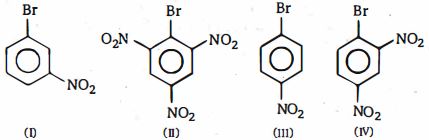
The decreasing order of reactivity of given compound towards nucleophilic  substitution with aqueous $NaOH$ is
When $800\,mL$ of $0.5\,M$ nitric acid is heated in a beaker, its volume is reduced to half and $11.5\,g$ of nitric acid is evaporated. The molarity of the remaining nitric acid solution is $x \times 10^{-2}\,M$.(Nearest Integer)(Molar mass of nitric acid is $63\,g\,mol ^{-1}$ )
The conjugate acid of $HPO_3^{2 - }$ is
Assuming that $\mathrm{Ba}(\mathrm{OH})_{2}$ is completely ionised in aqueous solution under the given conditions the concentration of $\mathrm{H}_{3} \mathrm{O}^{+}$ions in $0.005 \,\mathrm{M}$ aqueous solution of $\mathrm{Ba}(\mathrm{OH})_{2}$ at $298\, \mathrm{~K}$ is $.....\times 10^{-12}$ $mol$ $\mathrm{L}^{-1}$. (Nearest integer)
The number of monochloroproduct formed from $n-$ butane are
Hybridisation of carbon $C_2$ and $C_4$  respectively are  $CH_3-CH=CH-CH_3$
Consider the reactions given below. On the basis of these reactions find out which of the algebric relations given in options $(i)$ to $(iv)$ is correct?
  1. $\text{C}(\text{g})+4\text{H}(\text{g})\rightarrow\text{CH}_4(\text{g});\Delta_\text{r}\text{H}=\text{x}\text{kJ}\ \text{mol}^{-1}$
  2. $\text{C}(\text{graphite,s})+2\text{H}_2(\text{g})\rightarrow\text{CH}_4(\text{g});\Delta_\text{r}\text{H}=\text{y}\text{kJ}\ \text{mol}^{-1}$​​​​
The letter ‘$D$’ in carbohydrates represents
Which of the following equations is unbalanced?