MCQ
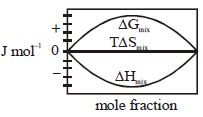
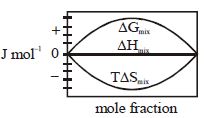
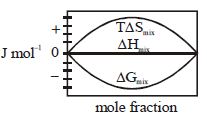
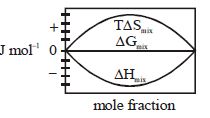
Which of the following represents correctly the changes in thermodynamic properties during the formation of $1\, mol$ of an ideal binary solution
  • A

  • B


  • D

Answer

Correct option: C.

c
When $1\, mole$ of an ideal binary solution is prepared, the enthalpy of mixing is $Jmol ^{-1}$

As the mole fraction increases, the free energy change of mixing first decreases, reaches a minimum value and then increases.

With increase in the mole fraction, the value of the term $T \Delta S _{\text {mix }}$ first increases, reaches a maximum value and then decreases.

Hence, option $C$ correctly represents the changes in thermodynamic properties during the formation of $1\, mole$ of an ideal binary solution.

Need a full question paper?

Generate a complete, print-ready paper with questions like this in minutes — across 16+ boards, with answer keys.

Start Generating Free

Similar questions

For the identification of $\beta$-naphthol using dye test, it is necesary to use : 
If the potential energy of the electron is $-10\,eV$ what is total energy? ................ $\mathrm{eV}$
The vapour pressure of two liquids $ P $ and $Q $ are $ 80 $ and $60\,torr$, respectively. The total vapour pressure of solution obtained by mixing $3\,mole$ of $ P $ and $ 2\,mole$ of $ Q $ would be .......... $torr$.
$CuSO_4(aq) + 4NH_3 \rightarrow X,$ then $X$ is
The hydrogen-like species $\mathrm{Li}^{2+}$ is in a spherically symmetric state $\mathrm{S}_1$ with one radial node. Upon absorbing light the ion undergoes transition to a state $\mathrm{S}_2$. The state $\mathrm{S}_2$ has one radial node and its energy is equal to the ground state energy of the hydrogen atom.

$1.$ The state $S_1$ is

$(A)$ $1 \mathrm{~s}$ $(B)$ $2 \mathrm{~s}$ $(C)$ $2 \mathrm{p}$ $(D)$ $3 \mathrm{~s}$

$2.$ Energy of the state $S_1$ in units of the hydrogen atom ground state energy is

$(A)$ $0.75$ $(B)$ $1.50$ $(C)$ $2.25$ $(D)$ $4.50$

$3.$ The orbital angular momentum quantum number of the state $S_2$ is

$(A)$ $0$ $(B)$ $1$ $(C)$ $2$ $(D)$ $3$

Give the answer question $1,2$ and $3.$

Under a given set of experimental conditions, with increase in the concentration of the reactants, the rate of a chemical reaction
Which of the following reaction does not form $PCl_3$ as one of the product
The concentration of hydronium $({H_3}{O^ + })$ ion in water is
The equivalent weight of an element is $4$. Its chloride has a $V.D$ $59.25$. Then the valency of the element is
Wine (alcoholic beverages) contains