MCQ
Which of the following shows hysteresis ?
  • A
    Paramagnetic materials
  • Ferromagnetic materials
  • C
    Diamagnetic materials
  • D
    None of these

Answer

Correct option: B.
Ferromagnetic materials
B

Need a full question paper?

Generate a complete, print-ready paper with questions like this in minutes — across 16+ boards, with answer keys.
Start Generating Free

Similar questions

The electric field in a region is radially outward with magnitude $E = {A \gamma_0}$. The charge contained in a sphere of radius ${\gamma_0}$ centered at the origin is
Conductivity of semiconductors due to increase in temperature :
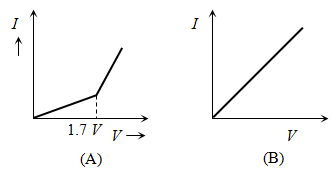
The $V-i$ graphs $A$ and $B$ drawn for two voltameters. Identify each graph
The period of oscillations of a magnet is 2 sec. When it is remagnetised so that the pole strength is 4 times its period will be(a) 4 sec               (b) 2 sec(c) 1 sec  (d) 1/2 sec
       
Which of the following is a mechanical wave?
  1. Radio waves.
  2. X-rays.
  3. Light waves.
  4. Sound waves.
Atomic weight of boron is $10.81$ and it has two isotopeses $5^{8^{10}}$ and $5^{8^{11}}$. Then ratio of $5^{8^{10}}: 5^{8^{11}}$ in nature would be
In the propagation of light waves, the angle between the plane of vibration & plane of polarisation is:
A long straight wire carrying current of $30 A$ is placed in an external uniform magnetic field of induction $4 \times 10^{-4} \mathrm{~T}$. The magnetic field is acting parallel to the direction of current. The magnitude of the resultant magnetic induction in tesla at a point $2.0 \ cm$ away from the wire is
A photon of energy 3.4 eV is incident on a metal having work function 2 eV. The maximum K.E. of photo-electrons is equal to(a) 1.4 eV(b) 1.7 eV(c) 5.4 eV                                           (d) 6.8 eV
       
Two concentric coplanar circular loops of radii $r_1$ and $r_2$ carry currents of respectively $i_1$ and $i_2$ in opposite directions $($one clockwise and the other anticlockwise.$)$ The magnetic induction at the centre of the loops is half that due to $i_1$ alone at the centre. If $r_1=r_2$. the value of $\frac{i_1}{i_2}$ is