MCQ
Which of the following solutions are acidic?
  • A
    $\mathrm{CuSO}_4$
  • B
    $\mathrm{CH}_3 \mathrm{COONH}_4$
  • $\mathrm{AlCl}_3$
  • D
    $\mathrm{Na}_2 \mathrm{CO}_3$

Answer

Correct option: C.
$\mathrm{AlCl}_3$
$(a)$ and $(c)$ are acidic.
Because they are salts of strong acid $\mathrm{H}_2 \mathrm{SO}_4$ and $\text{HCl}$ and weak bases $\mathrm{Cu}(\mathrm{OH})_2$ and $\mathrm{Al}(\mathrm{OH})_2$ respectively.

Need a full question paper?

Generate a complete, print-ready paper with questions like this in minutes — across 16+ boards, with answer keys.

Start Generating Free

Similar questions

Which of the following is the most stable alkene
The ratio of the mass percentages of $'C$ $\&$ $H'$ and $'C$ $\&$ $O'$ of a saturated acyclic organic compound$'X'$ are $4 : 1$ and $3 : 4$ respectively. Then, the moles of oxygen gas required for complete combustion of two moles of organic compound $'X$' is
Which element has maximum electron affinity
$40^{\circ}$ of $HI$ undergoes decomposition to $H _{2}$ and $I _{2}$ at $300\, K . \Delta G ^{\ominus}$ for this decompostion reaction at one atmosphere pressure is $...\,J\, mol ^{-1} \cdot$ [nearest integer]

(Use $R =8.31\, J\, K ^{-1}\, mol ^{-1} ; \log 2=0.3010$. In $10=$ $2.3, \log 3=0.477$ )

The correct shape and $I-I-I$ bond angles respectively in $I _{3}^{-}$ ion are :-
Select the compound from the following which dissolves in water
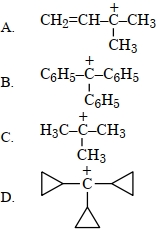
The decreasing order of hydride affinity for following carbocations is:

Choose the correct answer from the options given below:
Which one is a wrong statement ?
A sample of $\mathrm{CaCO}_3$ and $\mathrm{MgCO}_3$ weighed $2.21 \mathrm{~g}$ is ignited to constant weight of $1.152 \mathrm{~g}$. The composition of mix ture is :

(Given molar mass in $\mathrm{g} \mathrm{mol}^{-1}{CaCO}_3: 100, \mathrm{MgCO}_3: 84)$

Match list $I$ with list $II$ and select the correct answer
List $-I$ (Molecule / Species) List $-II$
$(P)$ $NO_2$ (Unpaired electron in) $(1)$ Vacant $p-$ orbital involved in hybridization
$(Q)$ $B_2H_6$ $(2)$ $sp^2-$ orbital
$(R)$ $ClO_3$ (Unpaired electron in) $(3)$ $sp^3-$orbital
$(S)$ $CH_3^+$ $(4)$ $120^o$ Bond angle