- A$n$ gives idea of the size of an orbital
- B$l$ gives the shape of an orbital
- ✓$m$ gives the energy of the electron in the orbital
- D$s$ gives the direction of spin of the electron in an orbital.
Generate a complete, print-ready paper with questions like this in minutes — across 16+ boards, with answer keys.
$(I)$ $\phi -CH_3$
$(II)$ $\phi -CH_2-CH_3$
$(III)$ $\phi -CH(CH_3)_2$
$(IV)$ $\phi-C(CH_3)_3$
towards electrophilic substitution will be - [where $\phi =C_6H_5$]
$Cu^{2+}_{(aq)} + e^- \rightarrow Cu^+_{(aq)}$ and $Cu^+_{(aq)} + e^- \rightarrow Cu_{(s)}$ are $+ 0.15\, V$ and $+ 0.50\, V$ respectively. The value of $E^o_{Cu^{2+}/Cu}$ will be ........ $V$
Where $A$ is $PCl^+_4$ while $B$ is $PCl^-_ 6$
Which of the following statement is INCORRECT :
$(I)$ $B$ to $A$ involvement of number of $d-$orbital in hybridization increases
$(II)$ $A$ to $B$ precentage of $p-$character in $P-Cl$ bond increases
$(III) $ Number of covalent bond in $A$ and $B$ are same
$(IV)$ $B$ is product of Lewis acid-base interaction which is associated with super octet molecule only
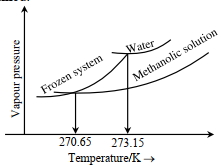
(Image)
$x=$.. . . . . .(nearest integer)
[Given: Molal freezing point depression constant of water at $273.15 \mathrm{~K}^2$ is $1.86 \mathrm{~K} \mathrm{~kg} \mathrm{~mol}^{-1}$ ]
