MCQ
Which of the following statement is correct about ionization potential?
  • A
    It is independent of atomic radii
  • B
    It remains constant with change in atomic radii
  • C
    It increases with an increase in atomic radii
  • It decreases with an increase in atomic radii
Answer

Correct option: D.
It decreases with an increase in atomic radii
d
The ionisation potential decreases with increase in atomic radii.

Need a full question paper?

Generate a complete, print-ready paper with questions like this in minutes — across 16+ boards, with answer keys.

Start Generating Free

Similar questions

.........  $gm$ weight of non-volatile solute having molecular weight $40$, which should be dissolve in $57\, g$ octane to reduce its vapour pressure to $80\%$.
Given below are two statements : one is labelled as Assertion A and the other is labelled as Reason R: Assertion A : Aryl halides cannot be prepared by replacement of hydroxyl group of phenol by halogen atom.
Reason R : Phenols react with halogen acids violently. In the light of the above statements, choose the most appropriate from the options given below:
The reaction ${N_2}{O_5}$ (in $CCl_4$ solution) $ \to 2N{O_2}$ (solution) $ + \frac{1}{2}{O_2}(g)$ is of first order in ${N_2}{O_5}$ with rate constant $6.2 \times {10^{ - 1}}{s^{ - 1}}.$ What is the value of rate of reaction when $[{N_2}{O_5}] = 1.25\,mole\,{l^{ - 1}}$
$IUPAC$ name of :

$\begin{array}{*{20}{c}}
  {C{H_3} - C - CH - C - OC{H_3}} \\ 
  {||\,\,\,\,\,\,\,\,\,|\,\,\,\,\,\,\,\,\,\,\,\,||\,\,\,\,} \\ 
  {\,O\,\,\,\,\,\,C = O\,O\,\,\,\,\,} \\ 
  {|\,\,\,\,\,\,\,\,} \\ 
  {C{H_3}\,\,} 
\end{array}$

The refluxing of ${(C{H_3})_2}NCOC{H_3}$with acid gives
What is the $[OH^-]$ in the final solution prepared by mixing $20.0\, mL$ of $0.050\, M\, HCl$ with $30.0\, mL$ of $0.10\, M\, Ba(OH)_2$ ? .......$M$
A strong base can abstract an $\alpha -$hydrogen from
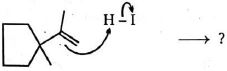
Taking into account the stability of various cycloalkanes and carbocations, as well as the rules governing mechanisms of carbocation rearrangements, what is the most likely product of this reaction ?
$IUPAC$ name of given compound is
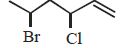
What is $IUPAC$ name of following compound ?