MCQ
Which of the following statement is correct?
  • A
    A person with myopia can see distant objects clearly.
  • B
    A person with hypermetropia can see nearby objects clearly.
  • C
    A person with myopia can see nearby objects clearly.
  • D
    A person with hypermetropia cannot see distant objects clearly.
Answer

  1. A person with myopia can see nearby objects clearly.

Explanation:

Hypermetropia: A person suffering from this defect can see far off objects clearly but cannot see nearby objects clearly.

Myopia: A person suffering from th is defect can see nearby objects clearly but cannot see far off objects clearly.

Need a full question paper?

Generate a complete, print-ready paper with questions like this in minutes — across 16+ boards, with answer keys.

Start Generating Free

Similar questions

An uncontrolled nuclear chain reaction forms the basis of:
  1. Nuclear power plant.
  2. Hydrogen bomb.
  3. Thermal power station.
  4. Atom bomb.
The heat produced in a wire of resistance 'x' when a current 'y' flows through it in time 'z' is given by:
Rays from Sun converge at a point 15cm in front of a concave mirror. Where should an object be placed so that size of its image is equal to the size of the object?
Lens of an eye is a transparent spherical structure which:
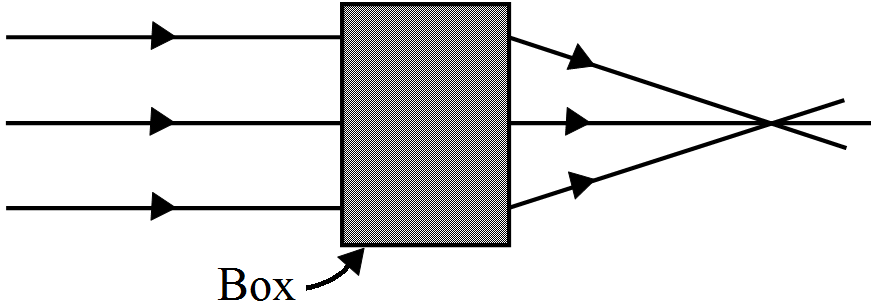
A beam of parallel light rays is incident through the holes on one side of a box and emerges out through the holes on its opposite side as shown in the diagram below:

Which of the following could be inside the box?
When sunlight is concentrated on a piece of paper by a spherical mirror or lens, then a hole can be burnt in it. For doing this, the paper must be placed at he focus of:
  1. Either a convex mirror or convex lens.
  2. Either a concave mirror or concave lens.
  3. Either a concave mirror or convex lens.
  4. Either a convex mirror or concave lens.
At the time of short circuit, the current in the circuit:
  1. Reduces substantially.
  2. Does not change.
  3. Increases heavily.
  4. Varies continuously.
An electric generator converts:
A D.C. generator is based on the principle of:
  1. Electrochemical induction.
  2. Electromagnetic induction.
  3. Magnetic effect of current.
  4. Heating effect of current.
Linear magnification (m) produced by a rear view mirror fitted in vehicles:
  1. Is equal to one.
  2. Is less than one.
  3. Is more than one.
  4. In be more less than one depending on the position of object.