MCQ
Which of the following statement is correct
  • A
    A good absorber is a bad emitter
  • B
    Every body absorbs and emits radiations at every temperature
  • C
    The energy of radiations emitted from a black body is same for all wavelengths
  • The law showing the relation of temperatures with the wavelength of maximum emission from an ideal black body is Plank’s law
Answer

Correct option: D.
The law showing the relation of temperatures with the wavelength of maximum emission from an ideal black body is Plank’s law
d
(d) A good absorber is a good emitter hence option $(a)$ is wrong. Every body stops absorbing and emitting radiation at $0\,K$ hence option $(b)$ is wrong.

The energy of radiation emitted from a black body is not same for all wavelength hence option $(c)$ is wrong.

Plank’s law relates the wavelength ($\lambda$) and temperature $(T)$ according to the relation

${E_\lambda }{d_\lambda } = \frac{{8\pi \,hc}}{{{\lambda ^5}}}\frac{1}{{[{e^{hc/kT}} - 1]}}{d_\lambda }$. Hence option $(d)$ is correct.

Need a full question paper?

Generate a complete, print-ready paper with questions like this in minutes — across 16+ boards, with answer keys.

Start Generating Free

Similar questions

A metre scale is balanced on a knife edge at its centre. When two coins, each of mass $10\, g$ are put one on the top of the other at the $10.0\, cm$ mark the scale is found to be balanced at $40.0\, cm$ mark. The mass of the metre scale is found to be $x \times 10^{-2}$ $kg$. The value of $x$ is
Mark the correct statements:
  1. The nuclear force between two protons is always greater than the electromagnetic force between them.
  2. The electromagnetic force between two protons is always greater than the gravitational force between them.
  3. The gravitational force between two protons may be greater than the nuclear force between them.
  4. Electromagnetic force between two protons may be greater than the nuclear force acting between them.
Two vectors $\dot{A}$ and $\dot{B}$ are defined as $\dot{A}=a \hat{i}$ and $\overrightarrow{\mathrm{B}}=\mathrm{a}(\cos \omega t \hat{\mathrm{i}}+\sin \omega t \hat{j}$ ), where a is a constant and $\omega=\pi / 6 \mathrm{rad} \mathrm{s}^{-1}$. If $|\overrightarrow{\mathrm{A}}+\overrightarrow{\mathrm{B}}|=\sqrt{3}|\overrightarrow{\mathrm{A}}-\overrightarrow{\mathrm{B}}|$ at time $t=\tau$ for the first time, the value of $\tau$, in, seconds, is. . . . . .
A bomb of mass $9 \,kg$ explodes into two pieces of masses $3 \,kg$ and $6 \,kg$. The velocity of mass $3 \,kg$ is $16 \,m / s$. The kinetic energy of mass $6 \,kg$ in joule is
An elastic spring under tension of $3 \mathrm{~N}$ has a lengtha. Its length is $b$ under tension $2 \mathrm{~N}$. For its length$(3 a-2 b)$, the value of tension will be_______. $\mathrm{N}$.
Velocity-time curve for a body projected vertically upwards is
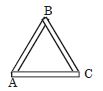
Three rods $AB, BC$ and $AC$ having thermal resistances of $10\, units, \,10 \,units$ and $20 \,units,$ respectively, are connected as shown in the figure. Ends $A$ and $C$ are maintained at constant temperatures of $100^o C$ and $0^o C,$ respectively. The rate at which the heat is crossing junction $B$ is   ........ $ \mathrm{units}$
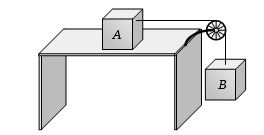
A block $A$ of mass $7 \,kg$ is placed on a frictionless table. A thread tied to it passes over a frictionless pulley and carries a body $B$ of mass $3\, kg$ at the other end. The acceleration of the system is .......... $ms^{-2}$          (given g = 10$m{s^{ - 2}})$
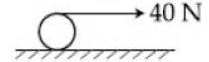
A string is wound around a hollow cylinder of mass $5\, kg$ and radius $0.5\,m$. If the string is now pulled with a horizontal force of $40\, N$, and the cylinder is rolling without slipping on a horizontal surface (see figure), then the angular acceleration of the cylinder will be ......... $rad/s^2$ .(Neglect the mass and thickness of the string)
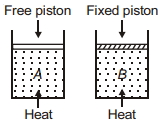
Two cylinders contain same amount of ideal monatomic gas. Same amount of heat is given to two cylinders. If temperature rise in cylinder $A$ is $T_0$ then temperature rise in cylinder $B$ will be .........