Question
Which of the following statement is false:

Answer

  1. Sound wave exhibits polarization while light wave does not.
Explanation:
Polarization is a property of waves that can oscillate with more than one orientation. Electromagnetic waves such as light exhibit polarization, as do some other types of wave, such as gravitational waves.
Sound waves in a gas or liquid do not exhibit polarization, since the oscillation is always in the direction the wave travels.

Need a full question paper?

Generate a complete, print-ready paper with questions like this in minutes — across 16+ boards, with answer keys.
Start Generating Free

Similar questions

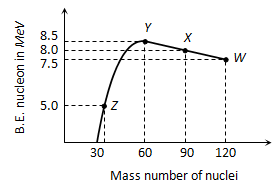
Binding energy per nucleon verses mass number curve for nuclei is shown in the figure. $\text{W, X, Y}$ and $Z$ are four nuclei indicated on the curve. The process that would release energy is

$Y \rightarrow 2Z$
$W \rightarrow X + Z$
$W \rightarrow 2Y$
$X \rightarrow Y + Z$
The graph drawn with object distance along abscissa & image as ordinate for a convex lens is
A person is suffering from myopic defect. He is able to see clear objects placed at 15 cm. What type and of what focal length of lens he should use to see clearly the object placed 60 cm away(a) Concave lens of 20 cm focal length  (b) Convex lens of 20 cm focal length  (c) Concave lens of 12 cm focal length  (d) Convex lens of 12 cm focal length 
   
   
The magnetic field produced at the centre of current carrying circular coil is :
Relative permeability of iron is $5500,$ then its magnetic susceptibility will be
The bending of light as it passes from one medium into another is commonly known as:
A proton enters in a straight line in a uniform magnetic field along the field direction. How will its path and velocity change?
A charged particle oscillates about its mean equilibrium position with a frequency of $109 \ Hz.$ The frequency of electromagnetic waves produced by the oscillator is$:$
Assertion :   Mass of ion is slightly differed from its element.
Reason    : Ion is formed, when some electrons are removed or added so mass changes.(a) If both assertion and reason are true and the reason is the correct explanation of the assertion.(b) If both assertion and reason are true but reason is not the correct explanation of the assertion.(c) If assertion is true but reason is false.(d) If the assertion and reason both are false.


A soap bubble is given negative charge, its radius will: