MCQ
Which of the following statement is not correct for the catalyst?
  • A
    It catalyses the forward and backward reaction to the same extent.
  • B
    It alters $\Delta\text{G}$ of the reaction.
  • C
    It is a substance that does not change the equilibrium constant of a reaction.
  • D
    It provides an alternate mechanism by reducing activation energy between reactants and products.
Answer

  1. It alters $\Delta\text{G}$ of the reaction.

Explanation:

A catalyst does not alter Gibbs energy, (G) of a reaction. It catalyses the spontaneous reactions but does not catalyse non-spontaneous reactions.

Need a full question paper?

Generate a complete, print-ready paper with questions like this in minutes — across 16+ boards, with answer keys.

Start Generating Free

Similar questions

Benzaldehyde on reaction with acetophenone in the presence of sodium hydroxide solution gives
For the reaction $A + B =2 C$, the speed of extinction of A is $10^{-2}$ mole litre 'second', then what will be the speed of formation of C ?
In the reaction,

$BrO_{3(aq)}^ - \, + \,5Br_{(aq)}^ - \, + \,6{H^ - }\, \to \,3B{r_{2(l)}}\, + \,3{H_2}{o_{(l)}}.$

The rate of appearance of bromine $(Br_2)$ is related to rate of disappearance of bromide ions as

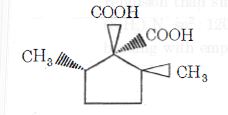
How many organic products will be formed when the following compound undergoes decarboxylation?
The diazonium salt of which of the following compounds will form a coloured dye on reaction with $\beta$ -Naphthol in $NaOH$ ?
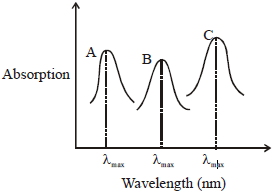
Simplified absorption spectra of three complexes $((i),$$( ii)$ and $( iii ))$ of $M ^{ n +}$ ion are provided below; their $\lambda_{\max }$ values are marked as $A, B$ and $C$ respectively. The correct match between the complexes and their $\lambda_{\max }$ values is

$(i)$ $\left[ M ( NCS )_{6}\right]^{(-6+ n )}$

$(ii)$ $\left[ MF _{6}\right]^{(-6+ n )}$

$(iii)$ $\left[ M \left( NH _{3}\right)_{6}\right]^{ n ^{+}}$

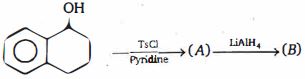
Product $(B)$ of the above reaction is
Impure phosphine is combustible due to presence of
Unlike other halogens fluorine does not show higher oxidation states because
What will be the molar conductance at infinite dilution for $NH_4OH$ if at infinite dilution the molar conductances of $Ba(OH)_2, BaCl_2$ and $NH_4Cl$ are $523.28, 280.0$ and $129.8\, ohm^{-1}\, cm^2\, mol^{-1}$ respectively.