Question
Which of the following statement is not true regarding Einsteins mass energy relation?

Answer

  1. Mass and energy can never be related to each other.

Need a full question paper?

Generate a complete, print-ready paper with questions like this in minutes — across 16+ boards, with answer keys.
Start Generating Free

Similar questions

For which of the following colour, the magnifying power of a microscope will be maximum(a) White colour (b)  Red colour (c) Violet colour (d)  Yellow colour 
       
Direction of induced current is determined by :
The temperature of a solid object is observed to be constant during a period. In this period:
  1. Heat may have been supplied to the body.
  2. Heat may have been extracted from the body.
  3. No heat is supplied to the body.
  4. No heat ia ertracted from the body.
If an α-particle collides head-on with a nucleus, what is its impact parameter?
Which of the following phenomena can be demonstrated by light. But not with sound waves in an air column? 
Assertion : Neutrons penetrate matter more readily as compared to protons.
Reason     : Neutrons are slightly more massive than protons.(a) If both assertion and reason are true and the reason is the correct explanation of the assertion.(b) If both assertion and reason are true but reason is not the correct explanation of the assertion.(c) If assertion is true but reason is false.(d) If the assertion and reason both are false.


Two wires of the same material are given. The first wire is twice as long as the second and has twice the diameter of the second. The resistance of the first will be(a) Twice of the second(b) Half of the second(c) Equal to the second(d) Four times of the second
   
   
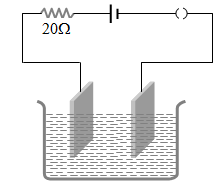
In a $Ag$ voltameter $2.68 \ gm$ of silver is deposited in $10$ min. The heat developed in $20 \Omega$ resistor during the same period will be
A charged particle goes undeflected in a region containing an electric and a magnetic field. It is possible that
  1. $\overrightarrow{\text{E}}||\overrightarrow{\text{B}},\ \overrightarrow{\text{v}}||\overrightarrow{\text{E}}$
  2. $\overrightarrow{\text{E}}$ is not parallel to $\overrightarrow{\text{B}}$
  3. $\overrightarrow{\text{v}}||\overrightarrow{\text{B}}$ but $\overrightarrow{\text{E}}$ is not parallel to $\overrightarrow{\text{B}}$
  4. $\overrightarrow{\text{E}}||\overrightarrow{\text{B}}$ but $\overrightarrow{\text{v}}$ is not parallel to $\overrightarrow{\text{E}}$
The mean electric energy density between the plates of a charged capacitor is $($here $q =$ charge on the capacitor and  $A =$ area of the capacitor plate$)$