MCQ
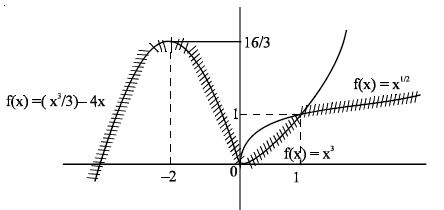
Which of the following statement is true for the function $f(x)\, = \,\,\,\left[ \begin{array}{l}\sqrt x \,\,\,\,\,\,\,\,\,\,\,\,\,\,x\,\, \ge \,1\\{x^3}\,\,\,\,\,\,\,\,\,\,\,\,\,\,\,0\, \le x\, \le 1\\\frac{{{x^3}}}{3}\, - \,4x\,\,\,\,\,x\,\, < \,0\end{array} \right.$
  • A
    It is monotonic increasing $\forall \,\,x\,\, \in \,\,R$
  • B
    $f' (x)$ fails to exist for $3$ distinct real values of $x$
  • $f' (x)$ changes its sign twice as $x$ varies from $(-\infty ,\infty )$
  • D
    function attains its extreme values at $x_1$ & $x_2 $, such that $x_1, x_2 > 0$
Answer

Correct option: C.
$f' (x)$ changes its sign twice as $x$ varies from $(-\infty ,\infty )$
c
COMMENTS: function is inc. in $(-\infty , -2) (0 , \infty )$

function is dec. in $(-2,0)$ 

$x = -2  \rightarrow$ local maxima

$x = 0  \rightarrow $ local minima

Derivable $\forall \,x\, \in \,R- {0,1} -\left[ \begin{array}{l}f\,'({0^ + })\, = \,0\,\,,\,\,f\,'({0^ - })\, = \, - 4\\f\,'\,({1^ + })\, = \,1/2\,,\,f\,'\,({1^ - })\, = \,3\end{array} \right.$

Continuous $\forall \,x\, \in \,R$.

Need a full question paper?

Generate a complete, print-ready paper with questions like this in minutes — across 16+ boards, with answer keys.

Start Generating Free

Similar questions

Choose the correct answer from the given four options.The solution of $\frac{\text{dy}}{\text{dx}}+\text{y}=\text{e}^{-\text{x}},$ y(0) = 0 is:
The differential equation $\frac{d y}{d x}=F(x, y)$ will not be a homogeneous differential equation, if $F(x, y)$ is:
A fair coin is tossed $99$ times. If $X$ is the number of times head appears, then $P(X = r)$ is maximum when $r$ is:
If $(a, b, c)$ is the image of the point $(1,2,-3)$ in the line, $\frac{x+1}{2}=\frac{y-3}{-2}=\frac{z}{-1},$ then $a+b+c$ is equal to
If $\big[2\vec{\text{a}}+4\vec{\text{b}}\vec{\text{c}}\vec{\text{d}}\big]=\lambda\big[\vec{\text{a}}\vec{\text{c}}\vec{\text{d}}\big]+\mu\big[\vec{\text{b}}\vec{\text{c}}\vec{\text{d}}\big],$ then $\lambda+\mu=$
The area of the region $\{(\text{x},\text{y}):\text{x}^2+\text{y}^2\leq1\leq\text{x}+\text{y}\}$ is:
Let ${I_1} = \int\limits_0^1 {\frac{{{e^x}}}{{\left( {1 + x} \right)}}} \,dx$ and ${I_2} = \int\limits_0^1 {\frac{{{x^2}}}{{{e^{{x^3}}}\left( {2 - {x^3}} \right)}}} \,dx$ then value of $\frac{{{I_1}}}{{{I_2}}}$ is equal to
The equation $y^2e^{xy} = 9e^{-3}·x^2$ defines $y$ as a differentiable function of $x$. The value of for $x = - 1$ and $y = 3$ is
$\int_{}^{} {\frac{{\tan x}}{{\sec x + \tan x}}\;dx = } $
Let $\mathrm{ABC}$ be a triangle of area $15 \sqrt{2}$ and the vectors $\overrightarrow{\mathrm{AB}}=\hat{i}+2 \hat{j}-7 \hat{k}, \quad \overrightarrow{B C}=a \hat{i}+b \hat{j}+c \hat{k}$ and $\overrightarrow{\mathrm{AC}}=6 \hat{\mathrm{i}}+\mathrm{d} \hat{\mathrm{j}}-2 \hat{\mathrm{k}}, \mathrm{d}>0$. Then the square of the length of the largest side of the triangle $\mathrm{ABC}$ is....................