MCQ
Which of the following statement is true
  • Absolute zero degree temperature is not zero energy temperature
  • B
    Two different gases at the same temperature pressure have equal root mean square velocities
  • C
    The root mean square speed of the molecules of different ideal gases, maintained at the same temperature are the same
  • D
    Given sample of $1\, cc$ of hydrogen and $1\, cc$ of oxygen both at $NTP;$ oxygen sample has a large number of molecules
Answer

Correct option: A.
Absolute zero degree temperature is not zero energy temperature
a
$(A)$ $\rightarrow K \cdot E$ is given by $\left(K \cdot E=\frac{3}{2} \cdot K_B \cdot T\right)$. If. $T$ is zero, then $K E$ will be zero. But the Potential Energy still remains It may or maynot be zero. Thus, Absolulé zero temperature is not zero energy temp. option $A$ is correct.

$(B)$ $\rightarrow$ R.Ms. velocity $=\sqrt{\frac{3 R T}{M}}$, So it depends on Mass olso. So two different gases will have different R.M.S velocities. So option $B$ is incorrect.

$(C)$ $\rightarrow$ Similar as above option B. R.M.S depends on molar mass also. So. option $C$ is ircorrect.

$(D)$ $\rightarrow$ No. of molecules $=\frac{\text { mass }}{\text { molar mass }}$ So, no. of molecules is inversely paportional to molar mass. The molar mass of oxygen molecules are more, so No. of molecules of oxygen will be less. option. $D$ is incorrect.

Need a full question paper?

Generate a complete, print-ready paper with questions like this in minutes — across 16+ boards, with answer keys.

Start Generating Free

Similar questions

A body projected along a frictionless inclined plane of angle of inclination $30^o$ covers a distance of $40\, m$ along the plane. If the body is projected with the same speed at angle of $30^o$ with the ground, it will have a range of : (Take $g = 10\, m/s^2$)
If opened door of a refrigerator in working condition kept in an insulated room:
Two bodies at different temperatures are mixed in a calorimeter. Which of the following quantities remains conserved?
In the isothermal expansion of $10\,g$ of gas from volume $V$ to $2V$ the work done by the gas is $575\,J$. What is the root mean square speed of the molecules of the gas at that temperature ..... $m/s$?
Displacement of a particle of mass $2\, kg$ moving in a straight line varies with time as $s  = (2t^3 + 2)\, m$. Impulse of the force acting on the particle over a time interval between $t = 0$ and $t = 1\, s$ is .......... $N-s$
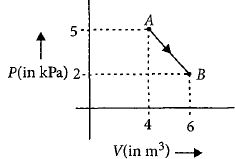
One mole of an ideal diatomic gas undergoes a transition from $A$ to $B$ along a path $AB$ as shown in the figure. 

The change in internal energy of the gas during the transition is ............$\;kJ$

A mass $M$ moving with a certain speed $V$ collides elastically with another stationary mass $m$. After the collision, the masses $M$ and $m$ move with speeds $V^{\prime}$ and $v$, respectively. All motion is in one dimension. Then,
The angle between $\vec{\text{A}}=\hat{\text{i}}+\hat{\text{j}}$ and $\vec{\text{B}}=\hat{\text{i}}-\hat{\text{j}}$ is
An elevator weighing $6000\, kg$ is pulled upward by a cable with an acceleration of $5\,m{s^{ - 2}}$. Taking g to be $10\,m{s^{ - 2}}$, then the tension in the cable is ........... $N$
An elevator in a building can carry a maximum of $10$ persons, with the average mass of each person being $68\; kg$. The mass of the elevator itself is $920\; kg$ and it moves with a constant speed $3\; \mathrm{m} / \mathrm{s}$. The frictional force opposing the motion is $6000 \;\mathrm{N}$. If the elevator is moving up with its full capacity, the power delivered by the motor to the elevator $\left(\mathrm{g}=10 \;\mathrm{m} / \mathrm{s}^{2}\right)$ must be at least .............. $\mathrm{W}$