MCQ
Which of the following statement is wrong
- ✓No inert gas is present in $7^{th}$ period
- B$3^{rd}$ period contains $18$ elements
- C$1^{st}$ period contains two non metals
- DIn $p-$ block, metal, nonmetal and metalloids are present
Generate a complete, print-ready paper with questions like this in minutes — across 16+ boards, with answer keys.
$C{H_3} - C \equiv C - H\xrightarrow{{NaN{H_2}}}\xrightarrow{{C{H_3} - I}}(A)\xrightarrow{{Li/liq\,N{H_2}}}(B)$
$C{H_3} - C \equiv C - H\xrightarrow{{NaN{H_2}}}\xrightarrow{{C{H_3} - I}}(A)\xrightarrow[{Pd.CaC{O_3}}]{{{H_2}}}(C)$
$(C= 3 \times 10^8 \,ms^{-1}$ and $N_A =6.02 \times mol^{-1}).$
$X + C{r_2}{O_3}\xrightarrow{\Delta }Y$ (Green coloured)
$X$ and $Y$ are
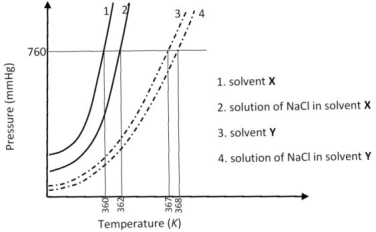
On addition of equal number of moles of a non-volatile solute $S$ in equal amount (in $kg$ ) of these solvents, the elevation of boiling point of solvent $X$ is three times that of solvent $Y$. Solute $S$ is known to undergo dimerization in these solvents. If the degree of dimerization is $0.7$ in solvent $Y$, the degree of dimerization in solvent $X$ is. . . . . . .