MCQ
Which of the following statements are true for wave motion:
  • A
    Mechanical transverse waves can propagate through all mediums.
  • B
    Longitudinal waves can propagate through solids only.
  • Mechanical transverse waves can propagate through solids only.
  • D
    Longitudinal waves can propagate through vacuum.

Answer

Correct option: C.
Mechanical transverse waves can propagate through solids only.
In case of mechanical transverse wave propagates through a medium, the medium particles oscillate right angles to the direction of wave motion or energy propagation. It travels in the form of crests and troughs.
When mechanical transverse wave propagates through a medium element of the medium is subjected to shearing stress. Solids and strings have shear modulus, that is why, sustain shearing stress. Fluids have no shape of their own, they yield to shearing stress. Transverse waves can be transmitted through solids, they can be setup on the surface of liquids. But they cannot be transmitted into liquids and gases.
Need a full question paper?

Generate a complete, print-ready paper with questions like this in minutes — across 16+ boards, with answer keys.

Start Generating Free

Similar questions

Two sound waves with wavelength $5.0m$ and $5.5m$ respectively, each propagate in a gas with velocity $330\ m/s.$ We expect the following number of beats/sec:
A physical quantity of the dimensions of length that can be formed out of $c, G$ and $\frac{e^2}{4\pi \varepsilon _0}$  is $[c$ is velocity of light, $G$ is the universal constant of gravitation and $e$ is charge $] $
The amount of heat energy required to raise the temperature of $1\, g$ of Helium at  $NTP,$ from $T_1 K$ to $T_2 K$ is 
$16$ tunning forks are arranged in the order of increasing frequencies. Any two successive forks give $8$ beats per sec when sounded together. If the frequency of the last fork is twice the first, then the frequency of the first fork is
The temperature at which the speed of sound in air becomes double of its value at ${27^o}C$ is ... $^oC$
A body of mass $M$ tied to a string is lowered at a constant acceleration of $(g/4)$ through a vertical distance $h$. The work done by the string will be..............
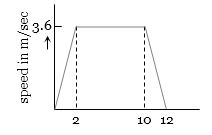
A lift is going up. The total mass of the lift and the passenger is $1500\, kg$. The variation in the speed of the lift is as given in the graph. The tension in the rope pulling the lift at $t = 11^{th}\, sec$ will be ............ $N$
Consider the wall of a dam to be straight with height $H$ and length $L$. It holds a lake of water of height $h (h < H)$ on one side. Let the density of water be $\rho_{ w }$. Denote the torque about the axis along the bottom length of the wall by $\tau_1$. Denote also a similar torque due to the water up to height $h / 2$ and wall length $L / 2$ by $\tau_2$. Then $\tau_1 / \tau_2$ (ignore atmospheric pressure) is
A particle is moving in $x y$-plane in a circular path with centre at origin. If at an instant the position of particle is given by $\frac{1}{\sqrt{2}}(\hat{i}+\hat{j})$, then velocity of particle is along .......
The equation of a progressive wave is given by $y = a\sin (628t - 31.4x)$

If the distances are expressed in cms and time in seconds, then the wave velocity will be ...... $cm/sec$