MCQ
Which of the following statements is correct
  • A
    $S{F_4}$ is polar and non-reactive
  • B
    $S{F_6}$ is non-polar and very reactive
  • C
    $S{F_6}$ is a strong fluorinating agent
  • D
    $S{F_4}$ is prepared by fluorinating $SC{l_2}$ with $NaF$

Answer

$SF _6$ is good florianating reagent. $SF _6$ is chemically inert due to the reason that the six $F$ atoms protect the sulphur atom from attack by the reagents to such an extent that even thermodynamically most favorable reactions like hydrolysis do not occur, that is non reactive. $SF _6$ is non polar.

Need a full question paper?

Generate a complete, print-ready paper with questions like this in minutes — across 16+ boards, with answer keys.

Start Generating Free

Similar questions

For the reaction $2N{O_{2(g)}}$ $\rightleftharpoons$ $2N{O_{(g)}} + {O_{2(g)}}$,${K_c} = 1.8 \times {10^{ - 6}}$ at $185\,^oC$. At $185\,^oC$ the $K_c$ for $N{O_{(g)}}$ $+$ $\frac{1}{2}{O_{2(g)}}$ $\rightleftharpoons$ $N{O_{2(g)}}$ is
Select the incorrect statement
Select incorrect statement
If the radius of the $3^{\text {rd }}$ Bohr's orbit of hydrogen atom is $r_{3}$ and the radius of $4^{\text {th }}$ Bohr's orbit is $r_{4}$. Then ....
Four species are listed below :

$i\,\, HCO_3$      $ii. \,H_3O^+$

$iii.\, HSO_4^-$       $iv.\, HSO_3F$

Which one of the following is the correct sequence of their acid strength?

The compounds that will give an isomer of  $2; 2-$ dimethyl propane on catalytic hydrogenation are

$(1)$ $\begin{array}{*{20}{c}}
  {C{H_3}CH = C - C{H_3}} \\ 
  {\,\,\,\,\,\,\,\,\,\,|} \\ 
  {\,\,\,\,\,\,\,\,\,\,\,\,\,\,\,\,C{H_3}} 
\end{array}$

$(2)$ $C{H_3}CH = CHC{H_3}$

$(3)$ $\mathop {C{H_3}C}\limits^{\begin{subarray}{l} 
  \,\,\,\,\,\,\,\,{\begin{array}{*{20}{c}}
  {}&H 
\end{array}} \\ 
  \,\,\,\,\,\,\,\,\,\,\,\,\,\,| 
\end{subarray} }  = CHC{H_2}C{H_3}$

$(4)$ $\begin{array}{*{20}{c}}
  {C{H_3}C = C - C{H_3}} \\ 
  {\,\,\,\,\,\,\,|\,\,\,\,\,\,\,\,\,\,\,\,|\,\,\,\,\,\,\,\,\,\,\,\,\,} \\ 
  {\,\,\,\,\,\,\,\,\,\,\,\,\,C{H_{3\,\,}}\,\,C{H_3}\,\,\,\,\,\,\,\,\,\,\,\,\,\,\,\,} 
\end{array}$
Covalent bond can undergo fission in two different ways. The correct representation involving a heterolytic fission of CH3—Br is:
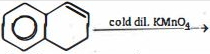
Product of the reaction is
In cyclic compounds, the bond-line formula for chlorocyclohexane is represented by which of the following representations?
Intramolecular $H-$ bond is present in