MCQ
Which of the following statements is incorrect?
  • A
    The bond angle follows the order

    $CH _{4}> NH _{3}> H _{2} O > H _{2} S$

  • The bond order follows the order

    $O _{2}^{+}> O _{2}> O _{2}^{-}> O _{2}^{2-}$

  • C
    Strength of $'H'$ bond follows the order

    $HF > H _{2} O > NH _{3}> HCl$

  • D
    Of $\overline{ O }- C \equiv \stackrel{+}{ O }$, $O = C = O,$ the structures,$\overline{ O }- C \equiv \stackrel{+}{ O }$ is most stable structure

Answer

Correct option: B.
The bond order follows the order

$O _{2}^{+}> O _{2}> O _{2}^{-}> O _{2}^{2-}$

b
$\overline{ O }- C \equiv \stackrel{+}{ O }$, $O = C = O$ બંધારણમાં $\overline{ O }- C \equiv \stackrel{+}{ O }$ એક વઘુ સ્થાયી બંધારણ છે.

Need a full question paper?

Generate a complete, print-ready paper with questions like this in minutes — across 16+ boards, with answer keys.

Start Generating Free

Similar questions

The enhanced force of cohesion in metals is due to
A first order reaction is $10\%$ completed in $20\, minutes$ then what will be the time for $19\%$ completion of reaction ...... $\min$
Following compounds are given

$(i)\,CH_3CH_2OH$

$(ii)\ CH_3COCH_3$

$(iii)\ \begin{array}{*{20}{c}}
  {C{H_3} - CHOH} \\ 
  {\,\,|} \\ 
  {\,\,\,\,\,\,C{H_3}} 
\end{array}$

$(iv) \,CH_3OH$

Which of the above compound(s), on being warmed with iodine solution and $NaOH,$ will give iodoform ?

The major product $(s)$ obtained in the following reaction is/ are
Based on the data given below:
$\begin{array}{l}
E_{Cr_2 O_7^{2-} / Cr^{3+}}^0=1.33 V \quad E_{C_2 / Cr^{(-1}}^0=1.36 V \\
E_{MnO_4^{-} / Mn^{2+}}^0=1.51 V \quad E_{Cr^{2+} / Cr}^0=-0.74 V
\end{array}
$
the strongest reducing agent is :
An excess of $AgNO_3$ is added to $100\, mL$ of a $0.01\, M$ solution of dichlorotetraaqua- chromium $(III)$ chloride. The number of moles of $AgCl$ precipitated would be
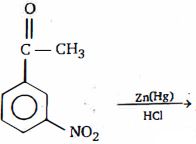
Product of the Clemmensen reduction is
When $100 \ mL$ of $1.0 \ M \ HCl$ was mixed with $100 \ mL$ of $1.0 \ M \ NaOH$ in an insulated beaker at constant pressure, a temperature increase of $5.7^{\circ} C$ was measured for the beaker and its contents (Expt. $1$). Because the enthalpy of neutralization of a strong acid with a strong base is a constant $\left(-57.0 \ kJ \ mol ^{-1}\right)$, this experiment could be used to measure the calorimeter constant. In a second experiment (Expt. $2$), $100 \ mL$ of $2.0 \ M$ acetic acid $\left(K_a=2.0 \times 10^{-5}\right)$ was mixed with $100 \ mL$ of $1.0 M \ NaOH$ (under identical conditions to Expt. $1$) where a temperature rise of $5.6^{\circ} C$ was measured.

(Consider heat capacity of all solutions as $4.2 J g ^{-1} K ^{-1}$ and density of all solutions as $1.0 \ g mL ^{-1}$ )

$1.$ Enthalpy of dissociation (in $kJ mol ^{-1}$ ) of acetic acid obtained from the Expt. $2$ is

$(A)$ $1.0$ $(B)$ $10.0$ $(C)$ $24.5$ $(D)$ $51.4$

$2.$ The $pH$ of the solution after Expt. $2$ is

$(A)$ $2.8$ $(B)$ $4.7$ $(C)$ $5.0$ $(D)$ $7.0$

Give the answer question $1$ and $2.$

Incorrect order is
Which one of the following process is non-spontaneous