MCQ
Which of the following statements is incorrect
  • A
    ${C_2}{H_5}Br$ reacts with alco. $KOH$ to form ${C_2}{H_5}OH$
  • B
    ${C_2}{H_5}Br$ when treated with metallic sodium gives ethane
  • C
    ${C_2}{H_5}Br$ when treated with sodium ethoxide forms diethyl ether
  • Both $(a)$ and $(b)$

Answer

Correct option: D.
Both $(a)$ and $(b)$
d
(d) ${C_2}{H_5}Br + alc{\rm{.}}K{\rm{OH}} \to {C_2}{H_4} + {H_2}O + KBr$

${C_2}{H_5}\,\boxed{Br + 2Na + Br} - {C_2}{H_5} \to \mathop {{C_2}{H_5} - {C_2}{H_5}}\limits_{{\text{Butane}}}  + 2NaBr$

Need a full question paper?

Generate a complete, print-ready paper with questions like this in minutes — across 16+ boards, with answer keys.

Start Generating Free

Similar questions

Graph in between heat capacity at constant pressure and temperature for a monatomic ideal gas
Which of the following is/are soluble in ethanol
Which of the following compound give yellow precipitate with ${I_2}$ and $NaOH$
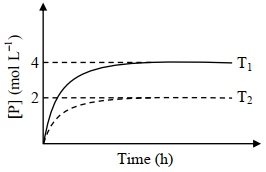
In a one-litre flask, 6 moles of $A$ undergoes the reaction $A(\mathrm{~g}) \rightleftharpoons \mathrm{P}(\mathrm{g})$. The progress of product formation at two temperatures (in Kelvin), $\mathrm{T}_1$ and $\mathrm{T}_2$, is shown in the figure:

If $T_1=2 T_2$ and $\left(\Delta G_2^{\Theta}-\Delta G_1^{\varphi}\right)=R T_2 \ln x$, then the value of $x$ is. . . . .

$\left[\Delta G_1^\theta\right.$ and $\Delta G_2^\theta$ are standard Gibb's free energy change for the reaction at temperatures $T_1$ and $T_2$, respectively.]

Acetylenic hydrogens are acidic because
In following reaction$yMnO_4^ - + x{H^ + } + {C_2}O_4^ - \to yM{n^{ + + }} + 2C{O_2} + \frac{x}{2}{H_2}O$, $x $ and $y $ are
Which element exist as a solid at $25\,^oC$ and $1$ atmospheric pressure among the following
An increase in equivalent conductance of a strong electrolyte with dilution is mainly due to
Match the compounds in $LIST-I$ with the observation in $LIST-II$, and choose the correct option.

$LIST-I$ $LIST-II$
$(I)$ Aniline $(P)$ Sodium fusion extract of the compound on boiling with $FeSO _4$, followed by acidification with conc. $H _2 SO _4$, gives Prussian blue color.
$(II)$ o-Cresol $(Q)$ Sodium fusion extract of the compound on treatment with sodium nitroprusside gives blood red color.
$(III)$ Cysteine $(R)$ Addition of the compound to a saturated solution of $NaHCO _3$ results in effervescence.
$(IV)$ Coprolactam $(S)$ The compound reacts with bromine water to give a white precipitate.
  $(T)$ Treating the compound with neutral $FeCl _3$ solution produces violet color.


Which of these will not react with acetylene