MCQ
Which of the following statements is incorrect?
  • A
    Young's modulus and shear modulus are relevant only for solids.
  • B
    Bulk modulus is relevant for liquids and gases.
  • C
    Metals have larger values of Young's modulus than elastomers.
  • D
    Alloys have larger values of Young's modulus than metals.
Answer

  1. Alloys have larger values of Young's modulus than metals.
Explanation:

Metals have larger values of Young's modulus than alloy and elastomers.

Need a full question paper?

Generate a complete, print-ready paper with questions like this in minutes — across 16+ boards, with answer keys.

Start Generating Free

Similar questions

The position of a particle along $x$-axis at time $t$ is given by $x=2+t-3 t^2$. The displacement and the distance travelled in the interval $t=0$ to $t=1$ are respectively
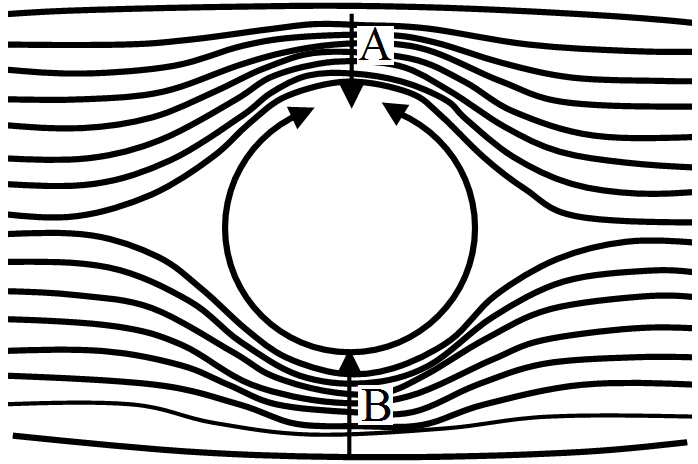
A ball is moving without spinning in a straight line through a fluid (as shown):

lf PA and PB, are pressure values at A and B, then,
A system has basic dimensions as density $[D]$, velocity $[V]$ and area $[A]$. The dimensional representation of force in this system is 
The maximum speed of a particle executing $S.H.M.$ is $1\,m/s$ and its maximum acceleration is $1.57\,m/se{c^2}$. The time period of the particle will be .... $\sec$
A unif orm non-deformable cylinder of mass $m$ and radius $R$ is rolling without slipping on a horizontal rough surface. The force of friction is
A body has speed $V, 2\,V$ and $3\,V$ in first $1/3$ of distance $S$, second $1/3$ of $S$ and third $1/3$ of $S$ respectively. Its average speed will be :-
A body of mass $40\,kg$ having velocity $4 \,m/s$ collides with another body of mass $60\,kg$ having velocity $2\, m/s$. If the collision is inelastic, then loss in kinetic energy will be .............. $J$
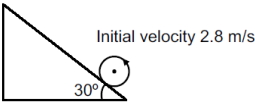
A sphere pure rolls on a rough inclined plane with initial velocity $2.8 \,m / s$. Find the maximum distance on the inclined plane. (in $m$)
The volume of air increases by $5\%$ in its adiabatic expansion. The percentage decrease in its pressure will be ...... $\%$
The root mean square velocity of the molecules in a sample of helium is $(5/7)^{th}$ that of the molecules in a sample of hydrogen. If the temperature of hydrogen sample is $0°C,$ then the temperature of the helium sample is about