Question
Which of the following statements is not correct?

Answer

(d)Magnetic susceptibility of ferromagnetic subs- tances is zero at Curie temperature.

Need a full question paper?

Generate a complete, print-ready paper with questions like this in minutes — across 16+ boards, with answer keys.

Start Generating Free

Similar questions

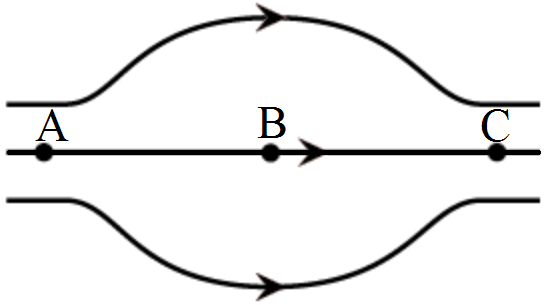
Figure, shows some of the electric field lines corresponding to an electric field. The figure suggests that,
The magnetic compass is not useful for navigation near the magnetic poles because(a) The magnetic field near the poles is zero(b) The magnetic field near the poles is almost vertical(c) At low temperature, the compass needle looses its magnetic properties(d) Neither of the above


Ozone layer protects us from which harmful radiations coming from the sun?
An ideal coil of $10$ henry is joined in series with a resistance of $5$ ohm and a battery of $5$ volt.  $2$ second after joining, the current flowing in ampere in the circuit will be
One proton beam enters a magnetic field of $10^{-4} T$ normally, Specific charge $= 10^{11} \mathrm{C} / \mathrm{kg}.$ velocity $ =10^7 \mathrm{~m} / \mathrm{s}.$ What is the radius of the circle described by it
 A charged conductor has its charge only on its outer surface. This statement is true for which of the following?
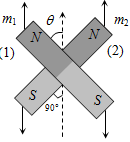
Two magnets of equal mass are joined at right angles to each other as shown the magnet $1$ has a magnetic moment $3$ times that of magnet $2.$ This arrangement is pivoted so that it is free to rotate in the horizontal plane. In equilibrium what angle will the magnet $1$ subtend with the magnetic meridian
A circular metal plate of radius $R$ is rotating with a uniform   angular velocity $ω$ with its plane perpendicular to a uniform magnetic field $B.$ Then the emf developed between the centre and the rim of the plate is
Consider the two idealized systems: (i) a parallel plate capacitor with large plates and small separation and (ii) a long solenoid of length L > > R, radius of cross-section. In (i) E is ideally treated as a constant between plates and zero outside. In (ii) magnetic field is constant inside the solenoid and zero outside. These idealised assumptions, however, contradict fundamental laws as below:
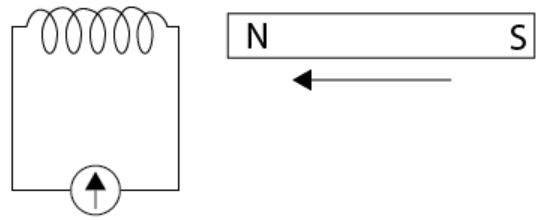
A magnet is moved into the coil of wire as shown, there is a small reading on the sensitive meter.
Which change would increase the size of the reading?
Image