MCQ
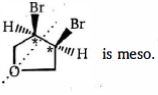
Which of the following structure represent meso-compound ?
- A
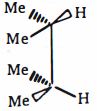
- ✓
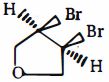
- C
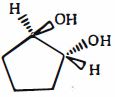
- D
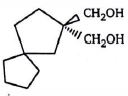
Generate a complete, print-ready paper with questions like this in minutes — across 16+ boards, with answer keys.
$(I)$ ${O_3} \to $ product
$(II)$ $C{r_2}O_7^{2 - }\xrightarrow{{{H^ + }}}$ product
$(III)$ $MnO_4^\Theta \xrightarrow{{{H^ + }}}$ product
$(IV)$ $H_2S \longrightarrow $ product
| List-I (Elements) | List-II(Properties in their respective groups) | ||
| A . | Cl,S | I. | Elements with highest electronegativity |
| B. | Ge, As | II. | Elements with largest atomic size |
| C. | Fr, Ra | III | Elements which show properties of both metals and non metal |
| D. | F, O | III | Elements with highest negative electron gain enthalpy |
(Consider heat capacity of all solutions as $4.2 J g ^{-1} K ^{-1}$ and density of all solutions as $1.0 \ g mL ^{-1}$ )
$1.$ Enthalpy of dissociation (in $kJ mol ^{-1}$ ) of acetic acid obtained from the Expt. $2$ is
$(A)$ $1.0$ $(B)$ $10.0$ $(C)$ $24.5$ $(D)$ $51.4$
$2.$ The $pH$ of the solution after Expt. $2$ is
$(A)$ $2.8$ $(B)$ $4.7$ $(C)$ $5.0$ $(D)$ $7.0$
Give the answer question $1$ and $2.$

$HC \equiv CH\mathop {\xrightarrow{{30\%\, {H_2}S{O_4}}}}\limits_{HgS{O_4}} A\xrightarrow{{NaOH}}B$