MCQ
Which of the statements below best describes a functional group?
  • A
    It is the non $-$ polar section of an organic molecule.
  • B
    It is a highly reactive group of elements with similar outer shell electron configurations.
  • It is an atom or a group of atoms which determines the chemical properties of a compound.
  • D
    It is the part of a chelate ligand attracted to the central ion.
Answer

Correct option: C.
It is an atom or a group of atoms which determines the chemical properties of a compound.
Functional groups are specific groups or recognizable group of atoms or bonds within molecules that are responsible for the characteristic chemical reactions of those molecules.
These functional group give characteristic properties to the carbon chain to which it is attached, e.g., aldehydic group or carboxylic group.

Need a full question paper?

Generate a complete, print-ready paper with questions like this in minutes — across 16+ boards, with answer keys.

Start Generating Free

Similar questions

Order of electron affinity of $F,\;Cl,\;Br$ and $I$ is .....
The reaction of toluene with $Cl_2$ in presence of $FeCl_3$ gives predominantly
Choose the correct $IUPAC$ name of the compound $C{H_3} - \mathop {\mathop {CH - }\limits^{|\,\,\,\,} }\limits^{C{H_3}} \mathop {\mathop {CH - }\limits^{|\,\,\,\,} }\limits^{C{H_3}} C \equiv C - C{H_3}$
Which among the following pairs of the structures will give different products on ozonolysis? (Consider the double bonds in the structures are rigid and not delocalized.)
A buffer solution is prepared in which the concentration of $NH_3$ is $0.30\, M$ and the concentration of $NH_4^+$ is $0.20\, M.$ If the equilibrium constant, $K_b$ for $NH_3$ equals $1.8 \times 10^{-5},$ what is the $pH$ of this solution ?  $(log \, 2.7 = 0.43)$
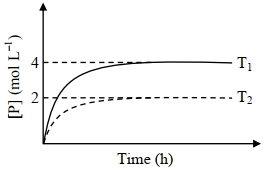
In a one-litre flask, 6 moles of $A$ undergoes the reaction $A(\mathrm{~g}) \rightleftharpoons \mathrm{P}(\mathrm{g})$. The progress of product formation at two temperatures (in Kelvin), $\mathrm{T}_1$ and $\mathrm{T}_2$, is shown in the figure:

If $T_1=2 T_2$ and $\left(\Delta G_2^{\Theta}-\Delta G_1^{\varphi}\right)=R T_2 \ln x$, then the value of $x$ is. . . . .

$\left[\Delta G_1^\theta\right.$ and $\Delta G_2^\theta$ are standard Gibb's free energy change for the reaction at temperatures $T_1$ and $T_2$, respectively.]

Litharge is chemically
A certain metal sulphide, $\ce{MS_2}$​, is used extensively as a high temperature lubricant. If $\ce{MS_2}$​ is $40.06\%$ by mass of sulphur, metal $M$ has atomic mass :
In Wurtz reaction, the reagent used is
In the neutral state the element $M$ consists of the isotopes $_{14}M^{28} , _{14}M^{29}$ and $_{14}M^{30}$ in the ratio $60 : 30 : 20$ respectively. Correct statements about $M$ in the natural state include that