MCQ
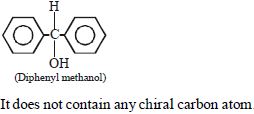
Which one among the following cannot exhibit enantiomerism ?
  • Diphenyl methanol
  • B
    $1-$ Bromo $-2-$ chlorobutane
  • C
    $2-$ Butanol
  • D
    Tartaric acid

Answer

Correct option: A.
Diphenyl methanol
a

Need a full question paper?

Generate a complete, print-ready paper with questions like this in minutes — across 16+ boards, with answer keys.
Start Generating Free

Similar questions

Complexes $\left(\mathrm{ML}_{5}\right)$ of metals $\mathrm{Ni}$ and $Fe$ have ideal square pyramidal and trigonal bipyramidal grometries, respectively. The sum of the $90^{\circ}, 120^{\circ}$ and $180^{\circ}\;\; \mathrm{L}-\mathrm{M}- \mathrm{L}$ angles in the two complexes is
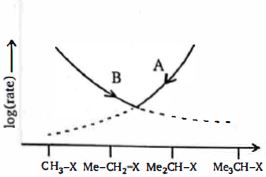
Which of the following is true about given graphs $A$ and $B$ ?
The results given in the below table were obtained during kinetic studies of the following reaction:

$2 A + B \longrightarrow C + D$

Experiment $[ A ] / molL ^{-1}$ $[ B ] / molL ^{-1}$ Initial $rate/molL$ $^{-1}$ $\min ^{-1}$
$I$ $0.1$ $0.1$ $6.00 \times 10^{-3}$
$II$ $0.1$ $0.2$ $2.40 \times 10^{-2}$
$III$ $0.2$ $0.1$ $1.20 \times 10^{-2}$
$IV$ $X$ $0.2$ $7.20 \times 10^{-2}$
$V$ $0.3$ $Y$ $2.88 \times 10^{-1}$

$X$ and $Y$ in the given table are respectively :
 

Which of the following reagents cannot distinguish between glucose and fructose ?
Which of the following is not an essential amino acid:
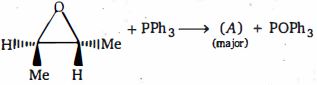
Product $(A)$ is
The correct statement $(s)$ among $I$ to $III$ with respect to potassium ions that are abundant within the cell fluids is/are :

$I.$ They activate many enzymes

$II.$ They participate in the oxidation of glucose to produce $ATP$

$III.$ Along with sodium ions, they are responsible for the transmission of nerve signals

Reaction of propanamide with ethanolic sodium hydroxide and bromine will give
On catalytic reduction $(H_2 /Pt)$ how many alkenes will give $n$ -butane ?
A $5\%\,w/v$ solution of cane sugar is isotonic with $1\%\,w/v$ solution of substance $X$ . The molecular weight of $X$ is