MCQ
Which one has $pH$ $12$
  • $0.01\,M\,\,KOH$
  • B
    $1\,N\,\,KOH\,\,ml$
  • C
    $1\,N\,NaOH\,\,ml$
  • D
    $3.0 \times {10^{ - 7}}\,M$

Answer

Correct option: A.
$0.01\,M\,\,KOH$
(a) $[O{H^ - }] = {10^{ - 2}}$ $M$ ; $pOH = 2$

$pH + pOH = 14$; $pH = 14 - pOH$

$pH = 14 - 2 = 12$

Need a full question paper?

Generate a complete, print-ready paper with questions like this in minutes — across 16+ boards, with answer keys.
Start Generating Free

Similar questions

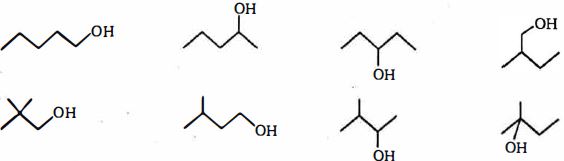
How many number of compounds, which have same $IUPAC$ name ?
Half-life period of a first order reaction is $1386$ seconds. The specific rate constant of the reaction is
Given the bond energies $N \equiv N,\,\,H - H$ and $N - H$ bonds are $945,\,436$ and $391\,kJ\,mol{e^{ - 1}}$ respectively, the enthalpy of the following reaction ${N_2}(g) + 3{H_2}(g) \to 2N{H_3}(g)$ is......$kJ$
Which of following species represent mixed anhydride ?
The stoichiometric reaction of $516 \mathrm{~g}$ of dimethyldichlorosilane with water results in a tetrameric cyclic product $X$ in $75 \%$ yield. The weight (in $g$ ) of $X$ obtained is. . . . . . . [Use, molar mass $\left(\mathrm{g} \mathrm{mol}^{-1}\right): \mathrm{H}=1, \mathrm{C}=12, \mathrm{O}=16, \mathrm{Si}=28, \mathrm{Cl}=35.5$ ]
In an octahedral structure, the pair of $d$ orbitals involved in ${d^2}s{p^3}$ hybridization is
The instantaneous rate of disappearance of $MnO_4^-$ ion in the following reaction is $4.56 \times 10^{-3}\, Ms^{-1}$

$2MnO_4^ -  + 10{I^ - } + 16{H^ + } \to 2M{n^{2 + }} + 5{I_2} + 8{H_2}O$

The rate of appearance $I_2$ is......$\times {10^{ - 2}}\,M{s^{ - 1}}$

At a certain temperature the equilibrium constant $K_c$ is $0.25$ for the reaction

${A_2}\left( g \right) + {B_2}\left( g \right) \rightleftharpoons {C_2}\left( g \right) + {D_2}\left( g \right)$

If we take $1\  mole$ of each of the four gases in a $10\  litre$ container, what would be equilibrium concentration of $A_2(g)$?

The complex ion has two optical isomers. Their correct configurations are :
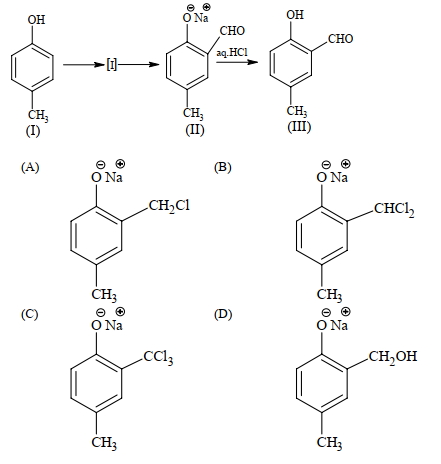
Reimer-Tiemann reaction introduces an aldehyde group, on to the aromatic ring of phenol, ortho to the hydroxyl group. This reaction involves electrophilic aromatic substitution. This is a general method for the synthesis of substituted salicyladehydes as depicted below.

$Image$

$1.$ Which one of the following reagents is used in the above reaction?

$(A)$ aq. $\mathrm{NaOH}+\mathrm{CH}_3 \mathrm{Cl}$

$(B)$ aq. $\mathrm{NaOH}+\mathrm{CH}_2 \mathrm{Cl}_2$

$(C)$ aq. $\mathrm{NaOH}+\mathrm{CHCl}_3$

$(D)$ aq. $\mathrm{NaOH}+\mathrm{CCl}_4$

$2.$ The electrophile in this reaction is

$(A)$ : $\mathrm{CHCl}$ $(B)$ ${ }^{+} \mathrm{CHCl}_2$

$(C)$ $\mathrm{CCl}_2$ $(D)$. $\mathrm{CCl}_3$

$3.$ The structure of the intermediate $I$ is

$Image$

Give the answer question $1, 2$ and $3.$