MCQ
Which one has the dimensions different from the remaining three
  • Power
  • B
    Work
  • C
    Torque
  • D
    Energy

Answer

Correct option: A.
Power
a
(a) Power = $\frac{{{\rm{Energy}}}}{{{\rm{Time}}}}$

Need a full question paper?

Generate a complete, print-ready paper with questions like this in minutes — across 16+ boards, with answer keys.
Start Generating Free

Similar questions

Two forces of 10 N each are acting at an angle $\theta^{\circ}$ at a point. Their resultant force is 10 N . The value of $\theta$ will be.
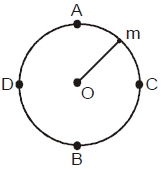
A mass is performing vertical circular motion (see figure). If The average velocity of the particle is increased, then at which point the string will break
A tuning fork resonates with a sonometer wire of length $1 \mathrm{~m}$ stretched with a tension of $6 \mathrm{~N}$. When the tension in the wire is changed to $54 \mathrm{~N}$, the same tuning fork produces $12$ beats per second with it. The frequency of the tuning fork is $\mathrm{Hz}$.
Choose the correct option.
The phase (at a time $t$) of a particle in simple harmonic motion tells
Two bodies of masses $0.1 \,kg$ and $0.4 \,kg$ move towards each other with the velocities $1\, m/s$ and $0.1 \,m/s$ respectively, After collision they stick together. In $10 \,sec$ the combined mass travels .......... $m$
At which temperature the speed of sound in hydrogen will be same as that of speed of sound in oxygen at $100\,^oC$  ..... $^oC$
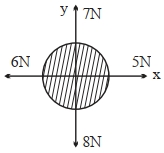
For a free body diagram shown in the figure, the four forces are applied in the ' $x$ ' and ' $y$ ' directions. What additional force must be applied and at what angle with positive $x$-axis so that the net acceleration of body is zero?
A wide vessel with a small hole at the bottom is filled with two liquids. The density and heightof one liquid are $\rho_1$ and $h_1$ and that of the otherare  $\rho_2$ and $h_2 \ (\rho_1 >\rho_2)$. The velocity of liquid coming out of the hole is :
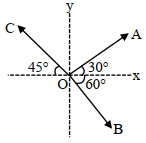
The magnitude of vectors $\overrightarrow{ OA }, \overrightarrow{ OB }$ and $\overrightarrow{ OC }$ in the given figure are equal. The direction of $\overrightarrow{ OA }+\overrightarrow{ OB }-\overrightarrow{ OC }$ with $x$-axis will be