MCQ
Which one in the following contains ionic as well as covalent bond
  • A
    $C{H_4}$
  • B
    ${H_2}$
  • $KCN$
  • D
    $KCl$

Answer

Correct option: C.
$KCN$
(c) Structure of $KCN$ is $[{K^ + }({C^ - } \equiv \mathop N\limits^{.\,\,.} )]$.

Need a full question paper?

Generate a complete, print-ready paper with questions like this in minutes — across 16+ boards, with answer keys.

Start Generating Free

Similar questions

Match List $I$ with List $II$

List $-I$

(Element)

  List $-II$ (Electronic Configuration)  
$A.$ $N$ $I.$ $[\mathrm{Ar}] 3 \mathrm{~d}^{10} 4 \mathrm{~s}^2 4 \mathrm{p}^5$
$B.$ $S$ $II.$ $[\mathrm{Ne}] 3 \mathrm{~s}^2 3 \mathrm{p}^4$
$C.$ $Br$ $III.$ $[\mathrm{He}] 2 \mathrm{~s}^2 2 \mathrm{p}^3$
$D.$ $Kr$ $IV.$ $[\mathrm{Ar}] 3 \mathrm{~d}^{10} 4 \mathrm{~s}^2 4 \mathrm{p}^6$

Choose the correct answer from the options given below:

For a thermodynamics process to be reversible, the temperature difference between hot body and the working substance should be :
$\,$
In reaction $A + 2B \rightleftharpoons 2C + D,$ initial concentration of $B$ was $1.5$  times of $[A]$, but at equilibrium the concentrations of $A$ and $B$ became equal. The equilibrium constant for the reaction is 
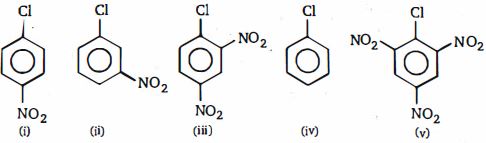
Arrange in their decreasing order of rate in $SN$Ar
Which of the following will have least hindered rotation about carbon-carbon bond
In Carius tube, an organic compound ' $X$ ' is treated with sodium peroxide to form a mineral acid ' $Y$ '. The solution of $BaCl _2$ is added to ' $Y$ ' to form a precipitate ' $Z$ '. ' $Z$ ' is used for the quantitative estimation of an extra element. ' $X$ ' could be:
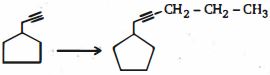
This conversion can be acheived by
Match list $I$ with list $II$ and select the correct answer
List $-I$ (Molecule / Species) List $-II$
$(P)$ $NO_2$ (Unpaired electron in) $(1)$ Vacant $p-$ orbital involved in hybridization
$(Q)$ $B_2H_6$ $(2)$ $sp^2-$ orbital
$(R)$ $ClO_3$ (Unpaired electron in) $(3)$ $sp^3-$orbital
$(S)$ $CH_3^+$ $(4)$ $120^o$ Bond angle
A certain orbital has $n =4$ and $m _{ L }=-3$. The number of radial nodes in this orbital is .......... (Round off to the Nearest Integer).