MCQ
Which one is not called a anode reaction from the following
- A$C{l^ - }\, \to \,\frac{1}{2}C{l_2} + {e^ - }$
- B$Cu\, \to \,C{u^{ + 2 }} + 2{e^ - }$
- C$H{g^ + }\, \to \,H{g^{ + 2 }} + {e^ - }$
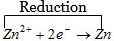
- ✓$Z{n^{2 + }} + 2{e^ - }\, \to \,Zn$
Generate a complete, print-ready paper with questions like this in minutes — across 16+ boards, with answer keys.
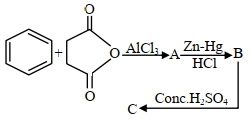
$(a)$ $NCl_3$ is formed when $Cl_2$ is present in excess.
$(b)$ $N_2$ is formed when $Cl_2$ is present in excess.
$(c)$ $N_2$ is formed when $NH_3$ is present in excess.
$(d)$ $NCl_3$ is formed when $NH_3$ is present in excess.
Correct option are
$F{e^{ + 3}}\left( {aq} \right) + {e^ - } \to F{e^{2 + }}\left( {aq} \right);{E^o} = + 0.77\,V$
$A{l^{ + 3}}\left( {aq} \right) + 3{e^ - } \to Al\left( s \right);{E^o} = - 1.66\,V$
$B{r_2}\left( {aq} \right) + 2{e^ - } \to 2B{r^ - };{E^o} = + 1.09\,V$
Considering the electrode potentials, which of the following represents the correct order of reducing power?