MCQ
Which one is not the property of charge?
- ACharge is additive.
- BCharge is conserved.
- CQuantization of charge.
- DA charge is self-destructive.
Explanation:
Electric charge possesses the properties of quantization, conservation of charge. It cannot be destroyed i.e. it is not self-destructive.
Generate a complete, print-ready paper with questions like this in minutes — across 16+ boards, with answer keys.
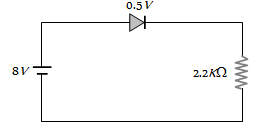
In the circuit, if the forward voltage drop for the diode is 0.5V, the current will be
|
(a) 3.4 mA |
(b) 2 mA |
(c) 2.5 mA |
(d) 3 mA |
The large scale destruction, that would be caused due to the use of nuclear weapons is called
|
(a) Nuclear holocaust |
(b) Thermo-nuclear reaction |
|
(c) Nuetron reproduction factor |
(d) None of these |
When objects at different distances are seen by the eye, which of the following remains constant
|
(a) The focal length of the eye lens |
(b) The object distance from the eye lens |
|
(c) The radii of curvature of the eye lens |
(d) The image distance from the eye lens |
If  is the original mass of the substance of half life period
  years, then the amount of substance left after 15 years is
|
(a) |
(b) |
(c) |
(d) |
The average binding energy per nucleon in the nucleus of an atom is approximately
|
(a) 8 eV |
(b) 8 KeV |
(c) 8 MeV |
(d) 8 J |
An electron microscope is superior to an optical microscope in
|
(a) Having better resolving power |
(b) Being easy to handle |
|
(c) Low cost |
(d) Quickness of observation |
A beam of light propagating in medium A with index of refraction n (A) passes across an interface into medium B with index of refraction n(B). The angle of incidence is greater than the angle of refraction; v(A) and v(B) denotes the speed of light in A and B. Then which of the following is true
|
(a) v(A) > v(B) and n(A) > n(B) |
(b) v(A) > v(B) and n(A) < n(B) |
|
(c) v(A) < v(B) and n(A) > n(B) |
(d) v(A) < v(B) and n(A) < n(B) |


