MCQ
Which one is paramagnetic from the following
  • A
    $O_2^ - $
  • B
    $NO$
  • Both $(a)$ and $(b)$
  • D
    $C{N^ - }$

Answer

Correct option: C.
Both $(a)$ and $(b)$
(c) $O_2^ - \,(2 \times 8 + 1 = 17)$ has odd number of electrons and hence it is paramagnetic.

All the remaining molecules/ions, i.e.,

$C{N^ - }(6 + 7 + 1 = 14)$ diamagnetic

$NO(7 + 8 = 15)$ has odd number of electrons and hence it is paramagnetic.

Need a full question paper?

Generate a complete, print-ready paper with questions like this in minutes — across 16+ boards, with answer keys.
Start Generating Free

Similar questions

No. of atoms in one molecule of sulphur is
Which of the following diazonium salt is relatively stable of $0-5\,^o C$ :
The vapour pressure of water at room temperature is $23.8\, mm\, Hg$. The vapour pressure of an aqueous solution of sucrose with mole fraction of $0.1$ is equal to .......... $mm\, Hg$.
The hypothetical complex triamminediaquachloro cobalt $(III)$ chloride can be represented as
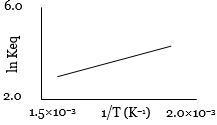
A schematic plot of versus inverse of temperature for a reaction is shown below The reaction must be
Given below are two statements :

Statement $I :$ The boiling points of the following hydrides of group $16$ elements increases in the order -
$H _{2} O < H _{2} S < H _{2} Se < H _{2} \text { Te. }$

Statement $II :$ The boiling points of these hydrides increase with increase in molar mass.
In the light of the above statements, choose the most appropriate answer from the options given below

$\mathop {C{H_3} - }\limits_a \mathop {C{H_2} - }\limits_b \mathop {C{H_2} - }\limits_c \mathop {C{H_2} - }\limits_d F$

Arrange the hydrogens $a, b, c, d$ in decreasing order of their reactivities towards chlorination

Identify the major product $\mathrm{C}$ formed in the following reaction sequence:

$Image$

Consider the reaction $N _{2} O _{4}( g ) \rightleftharpoons 2 NO _{2}( g )$

The temperature at which $K _{ C }=20.4$ and $K _{ P }=600.1,$ is ....... $K$. (Round off to the Nearest Integer).

[Assume all gases are ideal and $R =0.0831\, L\,bar \, K ^{-1} mol ^{-1}]$

Solution of $0.01$ $M$ $MgCl_2$ will form precipitate of $Mg(OH)_2$ at limiting $pH$ of Given : $K_{sp}$ of $Mg(OH)_2$ is $1 × 10^{-12}$