MCQ
Which one of following is charge less ?
  • A
    Alpha particle
  • B
    Beta particle
  • Photon particle
  • D
    Proton

Answer

Correct option: C.
Photon particle
C

Need a full question paper?

Generate a complete, print-ready paper with questions like this in minutes — across 16+ boards, with answer keys.
Start Generating Free

Similar questions

State the approximate potential difference applied between the anode and filament cathode ray tube.
The retarding potential for having zero photo-electron current(a) Is proportional to the wavelength of incident light(b) Increases uniformly with the increase in the wavelength of incident light(c) Is proportional to the frequency of incident light(d) Increases uniformly with the increase in the frequency of incident light wave


The phenomenon of change in the _____of light when it passes from one transparent medium to another is refraction.
Two equally charged spheres attract each other. Now if they touch each other then they will _____?
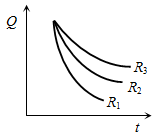
Three identical capacitors are given a charge $Q$ each and they are then allowed to discharge through resistance $R_1, R_2$ and $R_3.$ Their charges, as a function of time shown in the graph below. The smallest of the three resistance is
The magnetic field due to a straight conductor of uniform cross section of radius a and carrying a steady current is represented by 
Electric charges of $+10\ \mu C ,+5\ \mu C ,-3\ \mu C$ and $+8\ \mu C$ are placed at the corners of a square of side $\sqrt{2} m$. the potential at the centre of the square is
Assertion : The ionising power of b-particle is less compared to a-particles but their penetrating power is more.
Reason     : The mass of b-particle is less than the mass of a-particle.(a) If both assertion and reason are true and the reason is the correct explanation of the assertion.(b) If both assertion and reason are true but reason is not the correct explanation of the assertion.(c) If assertion is true but reason is false.(d) If the assertion and reason both are false.


The excess pressure inside a soap bubble is twice the excess pressure inside a second soap bubble. The volume of the first bubble is n times the volume of the second where n is:
  1. 4
  2. 2
  3. 1
  4. 0.125.
As compared to $^{12}C$ atom, $^{14}C$ atom has: