MCQ
Which one of the following combination represents a metallic element
  • A
    $2, 8, 7$
  • B
    $2, 8, 8$
  • C
    $2, 8, 4$
  • $2, 8, 2$

Answer

Correct option: D.
$2, 8, 2$
d
$(d) 2,8,2$. it would donate ${e^ - }$ more easily.

Need a full question paper?

Generate a complete, print-ready paper with questions like this in minutes — across 16+ boards, with answer keys.

Start Generating Free

Similar questions

Structure of $XeF_5^-$ is :
For complete combustion of methanol

$CH _{3} OH (1)+\frac{3}{2} O _{2}( g ) \rightarrow CO _{2}( g )+2 H _{2} O (1)$

the amount of heat produced as measured by bomb calorimeter is $726 \,kJ\, mol ^{-1}$ at $27^{\circ} C$. The enthalpy of combustion for the reaction is $- x \,kJ\,mol ^{-1}$, where $x$ is $.....$ (Nearest integer)

$\left(\right.$ Given $: R =8.3\, J\,K ^{-1} \,mol ^{-1}$ )

Product $(A)$ is
$6$ moles of an ideal gas expand isothermally and reversibly from a volume of $1$ litre to a volume of $10$ litres at $27\,^oC$. What is the maximum work done? ................. $\mathrm{kJ}$
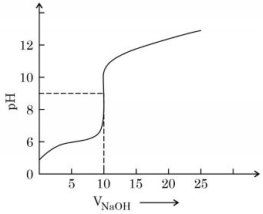
The titration curve of weak acid vs. strong base with phenolphthalein as indictor) is shown below. The $K _{\text {phenolphthalein }}=4 \times 10^{-10}$. Given: $\log 2=0.3$

The number of following statements which is/are correct about phenolphthalein is $.....$.

$A$. It can be used as an indicator for the titration of weak acid with weak base.

$B$. It begins to change colour at $pH =8.4$

$C$. It is a weak organic base

$D$. It is colourless in acidic medium
Silver chloride dissolves in
The solubility product of a sparingly soluble salt $A _{2} X _{3}$ is $1.1 \times 10^{-23}$. If specific conductance of the solution is $3 \times 10^{-5} \,S\, m ^{-1}$, the limiting molar conductivity of the solution is $x \times 10^{-3} \,S\, m ^{2}\, mol ^{-1}$. The value of $x$ is ...
the given is enol form of
Consider the complete combustion of butane, the amount of butane utilized to produce $72.0\, \mathrm{~g}$ of water is $....\,\times 10^{-1}\, \mathrm{~g} .$ (in nearest integer)
Which among the following reactions is favoured in forward direction by increase of temperature?