MCQ
Which one of the following elements forms compounds that are all coloured?
- AMagnesium.
- BAluminium.
- CIron.
- DChromium.
Explanation:
Most of the chromium compounds are coloured due to excitation of an electron from a lower energy d-orbital to higher energy d-orbital, the energy of excitation corresponds to the frequency of light absorbed. This frequency lies in a visible region. The colour observed corresponds to the complementary colour of light absorbed.
Generate a complete, print-ready paper with questions like this in minutes — across 16+ boards, with answer keys.

${P} \xrightarrow[\substack{\text { 2. } \mathrm{H}^{+}, \mathrm{H}_2 \mathrm{O} \\ \text { 3. } \mathrm{H}_2 \mathrm{SO}_4, \Delta}]{\text { 1. MeMgBr }}Q \xrightarrow[\text { 2. } \mathrm{Zn}, \mathrm{H}_2 \mathrm{O}]{1 . \mathrm{O}_3} {R} \xrightarrow[\text { 2. } \Delta]{1 . \mathrm{OH}^{-}} {S}$
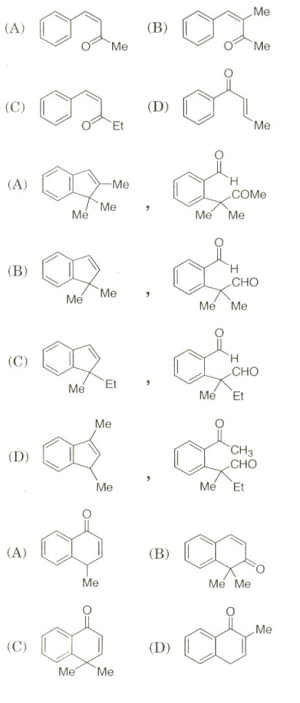
$1.$ The structure of the carbonyl compound ${P}$ is
$Image$
$2.$ The structures of the products ${Q}$ and ${R}$, respectively, are
$Image$
$3.$ The structure of the product ${S}$ is
$Image$
Give hte answer question $1,2$ and $3.$