MCQ
Which one of the following is dimensionless physical quantity?
  • Angle
  • B
    Stress
  • C
    Force gradient
  • D
    Velocity gradient

Answer

Correct option: A.
Angle
a
(a)

Need a full question paper?

Generate a complete, print-ready paper with questions like this in minutes — across 16+ boards, with answer keys.

Start Generating Free

Similar questions

A body cools from a temperature $3T$ to $2T$ in $10$ minutes. The room temperature is $T.$ Assume that Newton's law of cooling is applicable. The temperature of the body at the end of next $10$ minutes will be
A ball is released from the top of a tower of height $h$ meters. It takes $T$ seconds to reach the ground. What is the position of the ball in $\frac {T}{3}$ seconds
Bulk modulus was first defined by
$A$ man spinning in free space changes the shape of his body, $eg.$ by spreading his arms or curling up. By doing this, he can change his
On applying a stress of $20 \times {10^8}N/{m^2}$ the length of a perfectly elastic wire is doubled. Its Young’s modulus will be
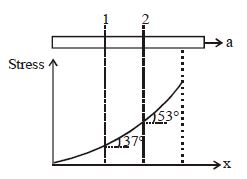
Rod of constant cross-section moves towards right with constant acceleration. Graph of stress and distance from left end is given as in figure. If density of material of rod at cross section $1$ is $9$ $\frac{{gm}}{{c{m^3}}}$ . Find density at cross section $2$.

 .......... $\mathrm{gm} / \mathrm{cm}^{3}$
A container with rigid walls is covered with perfectly insulating material. The container is divided into two parts by a partition. One part contains a gas while the other is fully evacuated (vacuum). The partition is suddenly removed. The gas rushes to fill the entire volume and comes to equilibrium after a little time. If the gas is not ideal, then
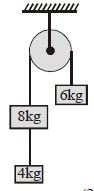
Three blocks of masses $4\,kg$, $6\,kg$ and $8\,kg$ are hanging over a fixed pulley as shown. The tension in the string connecting $8\,kg$ and $4\,kg$ block is
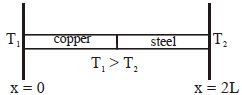
A copper rod and a steel rod of equal cross-sections and lengths $(L)$ are joined side by side and connected between two heat baths as shown in the figure

If heat flows through them from $x = 0$ to $x = 2L$ at a steady rate and conductivities of the metals are $K_{cu}$ and $K_{steel}$ $(K_{cu} > K_{steel}),$ then the temperature varies as (convection and radiation are negligible)
There have been suggestions that the value of the gravitational constant G becomes smaller when considered over very large time period (in billions of years) in the future. If that happens, for our earth,
  1. Nothing will change.
  2. We will become hotter after billions of years.
  3. We will be going around but not strictly in closed orbits.
  4. After sufficiently long time we will leave the solar system.