MCQ
Which one of the following is most soluble
  • A
    $CuS\,({K_{sp}} = 8 \times {10^{ - 37}})$
  • $MnS\,({K_{sp}} = 7 \times {10^{ - 16}})$
  • C
    $B{i_2}{S_3}\,({K_{sp}} = 1 \times {10^{ - 70}})$
  • D
    $A{g_2}S\,({K_{sp}} = 6 \times {10^{ - 51}})$

Answer

Correct option: B.
$MnS\,({K_{sp}} = 7 \times {10^{ - 16}})$
(b) Solubility is directly proportional to the ${K_{sp}}$.

Need a full question paper?

Generate a complete, print-ready paper with questions like this in minutes — across 16+ boards, with answer keys.
Start Generating Free

Similar questions

Consider the statements $S_1$ and $S_2$:
$S_1$: Conductivity always increases with decrease in the concentration of electrolyte.
$S_2$: Molar conductivity always increases with decrease in the concentration of electrolyte.
The correct option among the following is
How many grams of dibasic acid (mol. wt. $200$) should be present in $100\,ml$ of its aqueous solution to give decinormal strength .......... $gm$.
For the reaction ${N_2}(g) + 3{H_2}(g) \to 2N{H_3}(g)$ under certain conditions of temperature and partial pressure of the reactants, the rate of formation of $N{H_3}$ is $0.001\,kg\,{h^{ - 1}}$. The rate of conversion of ${H_2}$ under the same conditions is
${\Psi _{310}}$ has
Lattice enthalpy and enthalpy of solution of $NaCl$ are $788\, kJ mol ^{-1}$ and $4\, kJ\, mol ^{-1}$ respectively. The hydration enthalpy of $NaCl$ .......$\, kJ\, mol ^{-1}$
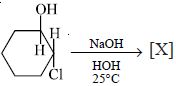
In the given reaction $[X]$ is
$S{O_2}$ acts as temporary bleaching agent but $C{l_2}$ acts as permanent bleaching agent. Why
Assertion : Addition of $NH_4OH$ to an aqueous solution of $BaCl_2$ in the presence of $NH_4Cl$ (excess) precipitates $Ba(OH)_2$.
Reason : $Ba(OH)_2$ is insoluble in water
An ornamental of gold having $75\%$ of gold, it is of .............. carat.
The $IE_1$ and $IE_2$ of three elements $A, B$ and $C$ are given as : ( $IE$ in $kJ/mol$ )

    $A$   $B$   $C$
  $IE_1$   $400$   $550$   $1150$
  $IE_2$   $2650$   $1070$   $2090$

Identify the element which represent a nonmetal.