MCQ
Which one of the following is not a base
  • A
    ${N_2}{H_4}$
  • B
    $N{H_2}OH$
  • C
    ${(C{H_3})_3}N$
  • $H{N_3}$

Answer

Correct option: D.
$H{N_3}$
d
Explanation:

$(A)$ hydrazoic acid $N _3 H$, dissociates into $N _3$ - and $H +$. Due to the formation of hydrogen ion, it is an acid.

$(B)$ In $N_2H_4$, nitrogen easily donates it's lone pair, so it is a base.

$(C)$ $NH_2 Oh$ is basic because it has hydroxyl ions.

$(D)$ The compound trimethylamine, $\left( CH _3\right)_3 N$, is a weak base when dissolved in water.

Need a full question paper?

Generate a complete, print-ready paper with questions like this in minutes — across 16+ boards, with answer keys.

Start Generating Free

Similar questions

A gas decolourises Bayer's reagent but does not react with Tollen's reagent, this gas is
$pH$  of a solution produced when an aqueous solution of $pH$ $6$  is mixed with an equal volume of an aqueous solution of $pH$ $3 $ is about
Which of the following element does not occur in liquid form
Among the following, the energy of $2s$ orbital is lowest in
Consider the following values of $IE(ev)$ for elements $W$ and $X$

Element  $IE_1$ $IE_2$ $IE_3$ $IE_4$
$W$ $10.5$ $15.5$ $24.9$ $79.8$
$X$ $8$ $14.8$ $78.9$ $105.8$

Other two elements $Y$ and $Z$ have outer electronic configuration $ns^2$ $np^4$ and $ns^2$ $np^5$ respectively. According to given information which of the following compound $(s)$ is/are not possible

$(a)\, W_2Y_3\, (b)\, X_2Y_3\, (c)\, WZ_2\, (d)\, XZ_2$

One mole of an ideal gas is expanded isothermally and reversibly to half of its initial pressure. $\Delta S$ for the process in $J\, K^{- 1}\, mol^{- 1}$ is $[ln\, 2\, = 0.693$ and $R\, = 8.314,\, J/(mol\, K)]$
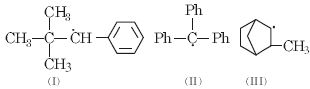
Consider the following compounds :

Hyperconjugation occurs in

In a nucleotide the phosphate linkage is generally attached to -
The treatment of an aqueous solution of $3.74 g$ of $Cu \left( NO _3\right)_2$ with excess $KI$ results in a brown solution along with the formation of a precipitate. Passing $H _2 S$ through this brown solution gives another precipitate $X$. The amount of $X ($in $g)$ is $ . . . .  [$Given : Atomic mass of $H =1, N =14, O =16, S =32, K =39, Cu =63, I =127 ]$
Assertion :Friedel-Craft's reaction is used to introduce an alkyl or acyl group in benzene nucleus.

Reason : Benzene is a solvent for the Friedel- Craft's alkylation of bromobenzene.