MCQ
Which one of the following shows maximum paramagnetic character
  • ${\left[ {Fe{{(CN)}_6}} \right]^{3 - }}$
  • B
    ${\left[ {Fe{{(CN)}_6}} \right]^{4 - }}$
  • C
    ${\left[ {Cr{{\left( {{H_2}O} \right)}_6}} \right]^{3 + }}$
  • D
    ${\left[ {Cu{{({H_2}O)}_6}} \right]^{2 + }}$
Answer

Correct option: A.
${\left[ {Fe{{(CN)}_6}} \right]^{3 - }}$
a
(i) $\left[F e(C N)_{6}\right]^{3-}$

Here, oxidation state of $F e=+3$

Electronic configuration of $F e$ (ground state) $=[A r] 3 d^{6} 4 s^{2}$

Electronic configuration of $F e$ (excited state) $=[A r] 3 d^{5} 4 s^{0}$

Number of unpaired electrons $=5$

(ii) $\left[F e(C N)_{6}\right]^{4-}$

Here, oxidation state of $F e=+2$

Electronic configuration of $F e$ (ground state) $=[A r] 3 d^{6} 4 s^{2}$

Electronic configuration of $F e$ (excited state) $=[A r] 3 d^{6} 4 s^{0}$

Number of unpaired electrons $=4$

(iii) $\left[\operatorname{Cr}\left(H_{2} O\right)_{6}\right]^{3+}$

Here, oxidation state of $C r=+3$

Electronic configuration of $C r^{3+}=[A r] 3 d^{3} 4 s^{0}$

Number of unpaired electrons $=3$

(iv) $\left[ Cu \left( H _{2} O \right)_{6}\right]^{2+}$

Here, oxidation state of $C u=+2$

Electronic configuration of $C u^{2+}=[A r] 3 d^{9} 4 s^{0}$

Number of unpaired electrons $=1$

A number of unpaired electrons present is directly proportional to a paramagnetic character.

So, $\left[ Fe ( CN )_{6}\right]^{3-}$ has maximum paramagnetic character.

Need a full question paper?

Generate a complete, print-ready paper with questions like this in minutes — across 16+ boards, with answer keys.

Start Generating Free

Similar questions

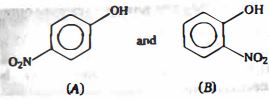
Out of the two compounds shown below, the vapour pressure of $B$ at a particular  temperature is expected to be
$\mathrm{C}_{6} \mathrm{H}_{5} \mathrm{NO}_{2} \stackrel{\mathrm{Sn}+\mathrm{HCl}}{\longrightarrow}A \,\xrightarrow[\mathrm{{H}^{\oplus}}]{\mathrm{C}_{6} \mathrm{H}_{5} \stackrel{\oplus}{\mathrm{N}}_{2} \stackrel{\Theta}{\mathrm{Cl}}}P$

$\quad\quad\quad\quad\quad\quad\quad\quad\quad\quad\quad\quad\quad$(Yellow coloured compound)

Consider the above reaction, the Product $"P"$ is:

A molal solution is one that contain 0.5 mole of a solute in :
Product of the reaction 

$\begin{array}{*{20}{c}}
  {\begin{array}{*{20}{c}}
  {\,\,\,\,C{H_2} - O - C{H_3}} \\ 
  {|\,\,\,\,\,\,\,\,\,\,\,\,\,\,\,\,\,\,\,\,\,\,\,\,\,\,\,\,\,\,\,\,\,\,\,\,\,} 
\end{array}} \\ 
  {\,\,CH - O - C{H_3}} \\ 
  {|\,\,\,\,\,\,\,\,\,\,\,\,\,\,\,\,\,\,\,\,\,\,\,\,\,\,\,\,\,\,\,\,\,\,\,\,} \\ 
  {\,\,C{H_2} - O - C{H_3}} 
\end{array}\xrightarrow{{HI(excess)}}$

The oxidation of benzene by $V_2O_5$ in the presence of air produces and high tempreture
Which of the following statement is not true about Mohr's salt
Reactant $(A)$ can be
Molar conductivity $\left(\Lambda_m\right)$ of aqueous solution of sodium stearate, which behaves as a strong electrolyte, is recorded at varying concentration($c$) of sodium stearate. Which one of the following plots provides the correct representation of micelle formation in the solution?

(Critical micelle concentration ($CMC$) is marked with an arrow in the figures.)

Polyvinylalcohol can be prepared by
How many moles of lead $(II)$ chloride will be formed from a reaction between $6.5\ g$ of $PbO$ and $3.2\ g\ HCl$ ?