MCQ
Which one of the following statement is true for transition elements
  • A
    They exhibit diamagnetism
  • B
    They exhibit inert pair effect
  • C
    They do not form alloys
  • They show variable oxidation states

Answer

Correct option: D.
They show variable oxidation states
d
(d) They show variable oxidation states due to participation of $(n - 1)$ $d-$ orbitals electrons with $ns $ orbital electrons.

Need a full question paper?

Generate a complete, print-ready paper with questions like this in minutes — across 16+ boards, with answer keys.

Start Generating Free

Similar questions

Carbon is in the lowest oxidation state in
Which of the following glass is used in making wind screen of automobiles
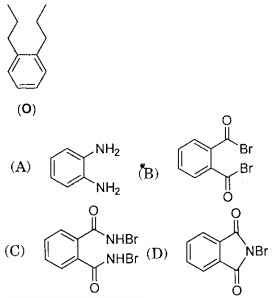
Treatment of compound $O$ with $KMnO_4 / \mathrm{H}^{+}$gave $P$, which on heating with ammonia gave $Q$. The compound $Q$ on treatment with $Br_2 / NaOH$ produced $R$. On strong heating, $Q$ gave $S$, which on further treatment with ethyl $2$-bromopropanoate in the presence of $KOH$ followed by acidification, gave a compound $T$.

(image)

($1$) The compound $R$ is

(image)

($2$) The compound $T$ is

($A$) glycine

($B$) alanine

($C$) valine

($D$) serine

Given the answer question ($1$) and ($2$) 
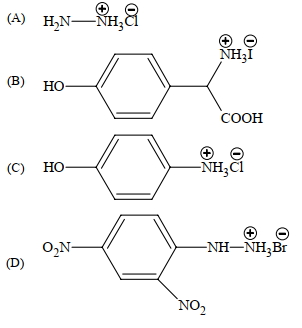
Match the compounds in Column $I$ with their characteristic test $(s)$ reaction $(s)$ given in Column $II$. Indicate your answer by darkening the appropriate bubbles of the $4 \times 4$ matrix gives in the $ORS$.
Column $I$ Column $II$
$Image$ $(p)$ sodium fusion extract of the compound gives Prussian blue colour with $\mathrm{FeSO}_4$
$Image$ $(q)$ gives positive $\mathrm{FeCl}_3$ test
$Image$ $(r)$ gives white precipitate with $\mathrm{AgNO}_3$
$Image$ $(s)$ reacts with aldehydes to form the corresponding hydrazone derivative

$\text{Phenol }\underset{\text{Distillation}}{\mathop{\xrightarrow{Zn}}}\,A\underset{\text{Conc}\text{. }HN{{O}_{3}}}{\mathop{\xrightarrow{\text{Conc}\text{. }{{H}_{2}}S{{O}_{4}}}}}\,B\underset{NaOH}{\mathop{\xrightarrow{Zn}}}\,C$   

In the above reaction  $A, B$  and $C $  are the following compounds

The molarity of concentrated sulphuric acid ( $d =1.834 g cm ^{-3}$ ) containing $95 \%$ of $H _2 SO _4$ by mass is
The structures of $O_3$ and $N_3^-$ are
For the following reaction in gaseous phase $CO\left( g \right) + \frac{1}{2}{O_2}\left( g \right) \to C{O_2}\left( g \right),{K_p}/{K_c}$ is
Largest in size out of $Na^+ , Ne$ and $F^-$ is
The orbital pictute of a triplet carbene can be drawn as