MCQ
Which one of the following statements is incorrect? 
  • A
    Rolling friction is smaller than sliding friction.
  • B
    Limiting value of static friction is directly proportional to normal reaction.
  • Coefficient of sliding friction has dimensions of length.
  • D
    Frictional force opposes the relative motion.
Answer

Correct option: C.
Coefficient of sliding friction has dimensions of length.
c
Coefficint of sliding friction has no dimention

$f=\mu_s N $

$\mu_s=\frac{f}{N}$

Need a full question paper?

Generate a complete, print-ready paper with questions like this in minutes — across 16+ boards, with answer keys.

Start Generating Free

Similar questions

If an average person jogs, he produces 14.5 × 10³ cal/ min. This is removed by the evaporation of sweat. The amount of sweat evaporated per minute (assuming 1kg requires 580 × 103cal for evaparation) is
The molar specific heat of a gas as given from the kinetic theory is $\frac{5}{2} R$. If it is not specified whether it is $C _{ P }$ or $C _{ V }$, one could conclude that the molecules of the gas
The average speed of the bob of a simple pendulum oscillating with a small amplitude $A$ and time period $T$ is
Water waves produced by a motor boat sailing in water are:
Which one of the following represents the displacement time graph of two objects A and B moving with zero relative speed?
Given $\left| {{\vec A_1}} \right| = 2,\,\left| {{\vec A_2}} \right| = 3$ and $\left| {{{\vec A}_1} + {{\vec A}_2}} \right| = 3$.  Find the value or $\left| {\left( {{{\vec A}_1} + 2{{\vec A}_2}} \right) \times \left( {3{{\vec A}_1} - 4{{\vec A}_2}} \right)} \right|$
A ball is thrown from a point with a speed ${v_o}$ at an angle of projection $\theta $. From the same point and at the same instant a person starts running with a constant speed ${v_o}/2$ to catch the ball. Will the person be able to catch the ball? If yes, what should be the angle of projection
Which of the following is not a physical quantity?
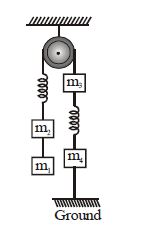
For the system shown in figure, $m_1>m_2>m_3 >m_4$ . Initially, the system is at rest in equilibrium condition. If the string joining $m_4$ and ground is cut, then just after the string is cut :

Statement $I$ $m_1$ ,$m_2$ ,$m_3$ remain stationary.

Statement $II$ The value of acceleration of all the $4$ blocks can be determined.

Statement $III$ Only $m_4$ remains stationary.

Statement $IV$ Only $m_4$ accelerates.

Statement $V$ All the four blocks remain stationary.

Now, choose the correct option.

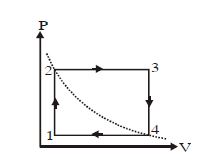
One mole of an ideal gas undergoes a cyclic process, consisting of two isochores and two isobars. Temperature at $1$ and $3$ equal to $T_1$ and $T_3$ respectively. The work done by the gas over the cycle, if the point $2$ and $4$ lie on the same isotherm