MCQ
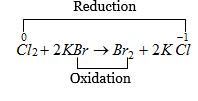
Which one will liberate $B{r_2}$ from $KBr$
- A${I_2}$
- B$S{O_2}$
- C$HI$
- ✓$C{l_2}$
Generate a complete, print-ready paper with questions like this in minutes — across 16+ boards, with answer keys.
$(i)$ Ionization $(ii)$ Hydrate $(iii)$ Coordination $(iv)$ Geometrical $(v)$ Optical
Which of the above isomerisms are exhibited by $[Cr(NH_3)_2 (OH)_2 Cl_2]^-$?
${CH}_3-\mathrm{CH}_2-\mathrm{CH}_2-\mathrm{Br} \xrightarrow[\Delta]{\mathrm{KOH}_{(a k)}} \mathrm{A} \xrightarrow{\mathrm{HBr}} \mathrm{B} \xrightarrow[\mathrm{KOH}_{(a) i}]{\Delta} \mathrm{C}$
$[ R =$ gas constant, $F =$ Faraday constant, $T =$ Temperature $]$
$(A)$ For the reaction, $M (s)+2 H ^{+}(a q) \rightarrow H _2(g)+ M ^{2+}(a q)$, if $\frac{ dE _{c o l l}}{ dT }=\frac{ R }{ F }$, then the entropy change of the reaction is $R$ (assume that entropy and internal energy changes are temperature independent).
$(B)$ The cell reaction, $Pt (s) \mid H _2(g, 1$ bar $)\left| H ^{+}(a q, 0.01 M ) \| H ^{+}(a q, 0.1 M )\right| H _2(g, 1 bar ) \mid Pt (s)$, is an entropy driven process.
$(C)$ For racemization of an optically active compound, $\Delta S >0$.
$(D)$ $\Delta S >0$, for $\left[ Ni \left( H _2 O \right)_6\right]^{2+}+3$ en $\rightarrow\left[ Ni ( en )_3\right]^{2+}+6 H _2 O$ (where en $=$ ethylenediamine).