MCQ
Which oxide will not given metal on heating:-
- A$HgO$
- ✓$ZnO$
- C$Ag_2O$
- DAll of these
On heating, $ZnO$ will not give $Zn$ metal.
However, it can be reduced with C or hydrogen to give free metal.
$ZnO + C \rightarrow Zn +[ CO ]$
$ZnO +[ CO ] \rightarrow Zn + CO _2$
$ZnO + H _2 \stackrel{\text { above } 400^{\circ} C }{\longrightarrow} Zn + H _2 O$
However, $HgO$ and $Ag _2 O$ on heating will give $Hg$ and $Ag$ respectively.
$2 HgO \rightarrow 2 Hg + O _2$
$2 Ag _2 O \rightarrow 4 Ag + O _2$
Generate a complete, print-ready paper with questions like this in minutes — across 16+ boards, with answer keys.
$Image$
In this reaction, $\mathrm{RCONHBr}$ is formed from which this reaction has derived its name. Electron donating group at phenyl activates the reaction. Hofmann degradation reaction is an intramolecular reaction.
$1.$ How can the conversion of $(i)$ to $(ii)$ be brought about?
$(A)$ $\mathrm{KBr}$ $(B)$ $\mathrm{KBr}+\mathrm{CH}_3 \mathrm{ONa}$ $(C)$ $\mathrm{KBr}+\mathrm{KOH}$ $(D)$ $\mathrm{Br}_2+\mathrm{KOH}$
$2.$ Which is the rate determining step in Hofmann bromamide degradation?
$(A)$ Formation of $(i)$ $(B)$ Formation of $(ii)$ $(C)$ Formation of $(iii)$ $(D)$ Formation of $(iv)$
$3.$ What are the constituent amines formed when the mixture of $(i)$ and $(ii)$ undergoes Hofmann bromamide degradation?
$Image$
give the answer question $1$, $2$, and $3.$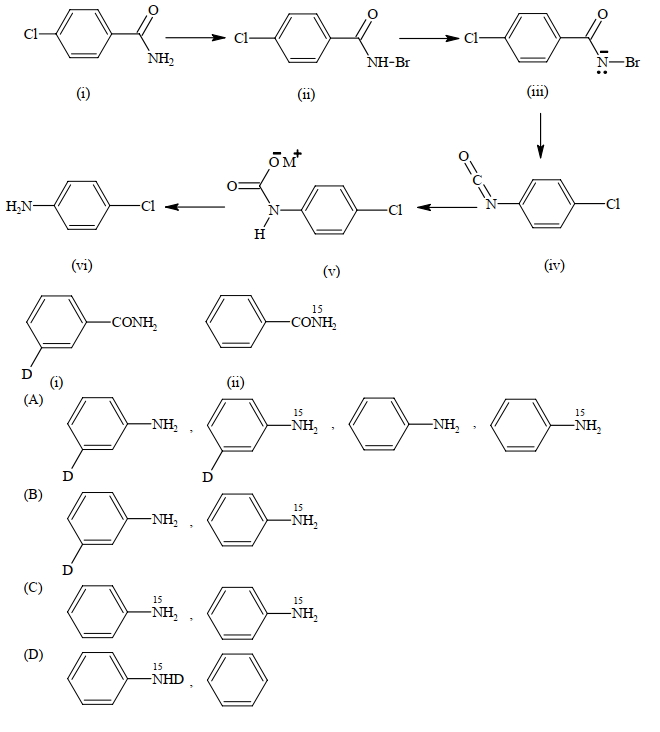
Given : $K _{ sp } Cu ( OH )_2=1 \times 10^{-20}$
$\operatorname{Take} \frac{2.303 RT }{ F }=0.059 \,V$
The reduction potential at $pH =14$ for the above couple is $(-) x \times 10^{-2}\,V$. The value of $x$ is $........$.
$6 OH ^{-}+ Cl ^{-} \rightarrow ClO _{3}^{-}+3 H _{2} O +6 e ^{-}$
If only $60 \%$ of the current is utilized in the reaction, the time (rounded to the nearest hour) required to produce $10\, g$ of $KCIO _{3}$ using a current of $2\, A$ is..........
(Given : $F =96,500\, C\, mol ^{-1}$ molar mass of $\left. KClO _{3}=122\,gmol ^{-1}\right)$