MCQ
Which pair has the same dimensions
  • A
    Work and power
  • B
    Density and relative density
  • Momentum and impulse
  • D
    Stress and strain

Answer

Correct option: C.
Momentum and impulse
(c) lmpulse = change in momentum so dimensions of both quantities will be same and equal to $M L T$

Need a full question paper?

Generate a complete, print-ready paper with questions like this in minutes — across 16+ boards, with answer keys.

Start Generating Free

Similar questions

Dimensions of $C R$ are those of
In steel, the Young's modulus and the strain at the breaking point are $2 \times 10^{11}\  Nm ^{-2}$ and $0.15$ respectively. The stress at the breaking point for steel is therefore
The voltage of an ac source varies with time according to the equation $V=100 \sin 100 \pi t \cos 100 \pi t$ where $t$ is in seconds and $V$ is in volts. Then
A force $\vec{F}=3 \hat{i}+\hat{c j}+2 \hat{k}$ acting on a particle causes a displacement $\vec{S}=-4 \hat{i}+2 \hat{j}-3 \hat{k}$ in its own direction. If the work done is 6J, then the value of $c$ will be
A current carrying rectangular coil is placed in a uniform magnetic field. In which orientation, the coil will not tend to rotate
A simple magnifying lens is used in such a way that an image is formed at $25 \mathrm{~cm}$ away from the eye. In order to have $10$ times magnification, the focal length of the lens should be
Which one of the following substances possesses the highest elasticity
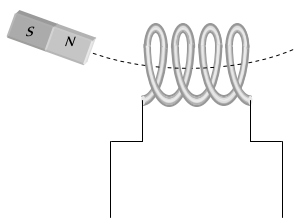
A magnet is made to oscillate with a particular frequency, passing through a coil as shown in figure. The time variation of the magnitude of e.m.f. generated across the coil during one cycle is
Image
A thermocouple of resistance $1.6 \Omega$ is connected in series with a galvanometer of $8 \Omega$ resistance. The thermocouple develops and e.m.f. of $10 \mu V$ per degree temperature difference between two junctions. When one junction is kept at $0^{\circ} C$ and the other in a molten metal, the galvanometer reads 8 millivolt. The temperature of molten metal, when e.m.f. varies linearly with temperature difference, will be
An electron (charge $=1.6 \times 10^{-19} \mathrm{C}$ ) is accelerated through a potential of $100,000 \mathrm{~V}$. The energy acquired by the electron is