MCQ
Which pair of elements can form multiple bond with itself and oxygen?
  • A
    $F, N$
  • B
    $N, Cl$
  • C
    $N, P$
  • $N, C$

Answer

Correct option: D.
$N, C$
d
Carbon and Nitrogen has a unique ability to form $\mathrm{p} \pi-\mathrm{p} \pi$ multiple bonds with itself and with other atoms of small size and high electronegativity.

Few examples of multiple bonding are $\mathrm{C}=\mathrm{C}, \mathrm{C}=\mathrm{O}, \mathrm{N}=\mathrm{C}$

Hence option D is a correct answer.

Need a full question paper?

Generate a complete, print-ready paper with questions like this in minutes — across 16+ boards, with answer keys.

Start Generating Free

Similar questions

One mole of an ideal gas is allowed to expand reversibly and adiabatically from a temperature of ${27\,^o}C$. If the work done during the process is $3 \,kJ, $ the final temperature will be equal to $({C_v} = 20\,J\,{K^{ - 1}})$
An element, $X$ has the following isotopic composition :

$^{200}X \,:\, 90\%$       $^{199}X\, :\, 8.0\%$       $^{202}X\, :\, 2.0\%$

The weighted average atomic mass of the naturally occurring element $X$ is closest to......$amu$

Which of the following reactions generates the major product ? Ignore stereoisomerism.
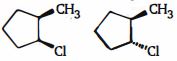
Optically active isomer $(A)$ of $(C_5H_9Cl)$ on treatment with one mole of $H_2$ gives an optically inactive compound $(B)$ compound $(A)$ will be
 Correct statement about $C$ and $D$ is

$C{H_3} - C \equiv C - C{H_3}\xrightarrow{{{H_2}/Pd - BaS{O_4}}}$ $A\xrightarrow{{B{r_2}/CC{l_4}}}C$

$C{H_3} - C \equiv C - C{H_3}\xrightarrow{{Na/Liq.\,N{H_3}}}$ $B\xrightarrow{{B{r_2}/{H_2}O}}D$

For the reaction

$H _{2} F _{2( g )} \rightarrow H _{2( g )}+ F _{2( g )}$

$\Delta U =-59.6\,kJ\,mol ^{-1} \text { at } 27^{\circ}\,C$.

The enthalpy change for the above reaction is (-) $kJ mol ^{-1}$ [nearest integer] Given : $R =8.314\,JK ^{-1}\,mol ^{-1}$
Calculate the enthalpy change on freezing of 1.0 mol of water at $10.0^{\circ} C$ to the ice at $-10.0^{\circ} C . \Delta_{\text {fus }} H =6.03 kJ$ $\operatorname{mol}^{-1}$ at $0^{\circ} C$.
a. $C _{ P }\left[ H _2 O ( l )\right]=75.3 Jmol ^{-1} K^{-1}$
b. $C _{ P }\left[ H _2 O ( s )\right]=36.8 Jmol ^{-1} K^{-1}$
Borax bead test is not used to identify cation in:
The following compounds are identical with respect to
Which of the following is least reactive towards electrophilic substitution