MCQ
Which pair represents chain isomer
- A$C{H_3}CHC{l_2}$ and $ClC{H_2}C{H_2}Cl$
- B$n-$propyl alcohol and isopropyl alcohol
- C$2-$methyl$-1$ propanol and $2-$Methyl$-2$ propanol
- ✓$2-$methyl butane and neopentane
$2$-methyl butane
$\begin{matrix} C{{H}_{3}} \\ | \\ C{{H}_{3}}-C-C{{H}_{3}} \\ | \\ C{{H}_{3}} \\ \end{matrix}$
neo pentane
Since, they have same molecular formula but they differ in branching. So they are chain isomer.
Generate a complete, print-ready paper with questions like this in minutes — across 16+ boards, with answer keys.
$N{H_3}(g) \rightleftharpoons \frac{1}{2}{N_2}(g) + \frac{3}{2}{H_2}(g)$ What is the $K_P$ for following reaction ? ${N_2}(g) + 3{H_2}(g) \rightleftharpoons 2N{H_3}(g)$
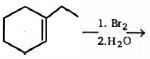
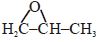
$n-$propyl bromide $\xrightarrow{{Na}}(A)\xrightarrow[{A{l_2}{O_3}/773\,K}]{{Cr{O_3}}}(B)\xrightarrow[{500\,K}]{{C{l_2}/UV}}(C)$
$n-$propyl bromide $\xrightarrow{{Na}}(A)\xrightarrow[{A{l_2}{O_3}/773\,K}]{{Cr{O_3}}}(B)$ $\xrightarrow[{}]{{C{H_3} - Cl/AlC{L_3}}}(D)\xrightarrow{{C{l_2}/hv}}(E)$