Question
Which part of electromagnetic spectrum has largest penetrating power?

Answer

$\gamma$Rays.

Need a full question paper?

Generate a complete, print-ready paper with questions like this in minutes — across 16+ boards, with answer keys.
Start Generating Free

Similar questions

When the size of a soap bubble is increased by pushing more air in it, the surface area increases. Does it mean that the average separation between the surface molecules is increased?
Two coils one of larger radius $R$ and other of smaller radius $r$ are kept near. If mutual induction coefficient for this pair is $1 mH$ what is the magnetic flux associated with the larger coil when a current of $0.5 A$ is flowing in the smaller coil? When current in smaller coil is zero then what is its effect on larger coil?
What is the value of the electric field produced by charge $Q$ at any point $\vec{r}$ ?
When the skeleton of an elephant and the skeleton of a mouse are prepared in the same size, the bones of the elephant are shown thicker than those of the mouse. Explain why the bones of an elephant are thicker than proportionate. The bones are expected to withstand the stress due to the weight of the animal.
For normal state of atom, quantum number $n=1$. What is the value of $n$ for ionised state?
What is the geometrical shape of equipotential surfaces due to a single isolated charge?
Find the thickness of a plate which will produce a change in optical path equal to half the wavelength $\lambda$ of the light passing through it normally. The refractive index of the plate is $\mu$.
Name the electromagnetic waves that have frequencies greater than those of ultraviolet light but less than those of gamma rays.
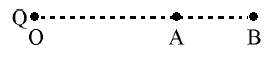
A point charge $Q$ is placed at point $O$ as shown in the figure. The potential difference $V_A – V_B$ positive. Is the charge $Q$ negative or positive$?$
A photographic plate is placed directly in front of a small diffused source in the shape of a circular disc. It takes $12s$ to get a good exposure. If the source is rotated by $60^\circ$ about one of its diameters, the time needed to getthe same exposure will be: