Question
Which physical terms remain conserved in an inelastic collision?

Answer

In an inelastic collision, total momentum as well as total energy remain conserved.

Need a full question paper?

Generate a complete, print-ready paper with questions like this in minutes — across 16+ boards, with answer keys.
Start Generating Free

Similar questions

Two satellites of equal masses, which can be considered as particles, are orbiting the earth at different heights. Will their moments of inertia be same or different?
Three vessels have same base area and different neck area. Equal volume of liquid is poured into them, which will possess more pressure at the base?
A body of mass 2kg initially at rest moves under the action of an applied horizontal force of 7N on a table with coefficient of kinetic friction = 0.1. Compute the: Work done by the applied force in 10s.
When a dielectric slab is gradually inserted between the plates of an isolated parallel-plate capacitor, the energy of the system decreases. What can you conclude about the force on the slab exerted by the electric field?
The increase in the speed of a car is proportional to the additional petrol put into the engine. Is it possible to accelerate a car without putting more petrol or less petrol into the engine?
Why does a spinning cricket ball in air not follow a parabolic path?
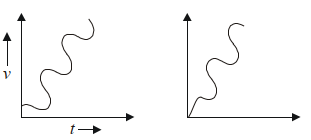
Do the two diagrams given below show the same type of motion or not? Write the name of the motion of the particle.
Image
Read the following two statements below carefully and state, with reasons, if it is true or false. The stretching of a coil is determined by its shear modulus.
What is the main difference between forced oscillations and resonance?
Show that the minimum energy needed to separate a proton from a nucleus with Z protons and N neutrons is:$\Delta\text{E}=(\text{M}_{\text{Z}-1,\text{N}}+\text{M}_{\text{H}}-\text{M}_{\text{Z,N}})\text{c}^2$
where $M_{Z N}=$ mass of an atom with $Z$ protons and $N$ neutrons in the nucleus and $M_H=$ mass of a hydrogen atom. This energy is known as proton-separation energy.